
Half My Room Lost Power, No Breaker Tripped: 6 Causes
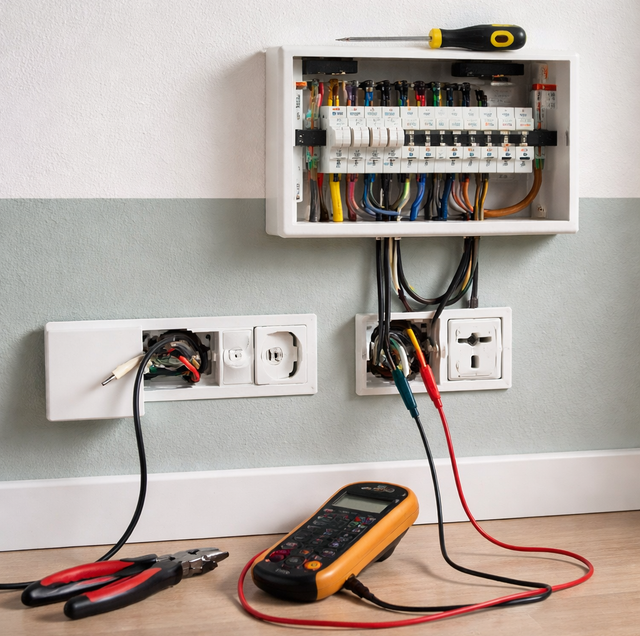
Quick Answer: When part of a room loses power, but no breaker looks tripped, the most common cause is a tripped GFCI outlet somewhere upstream that feeds the dead outlets. Reset the GFCIs in nearby bathrooms, the kitchen, the garage, and outdoors first. If that does not fix it, the next suspects are a breaker that tripped only halfway, a loose or failed wire connection breaking the chain, or a switch controlling a half-hot outlet.
You flip on a lamp, and nothing happens. The outlet next to it is dead too, and so is the one behind the couch, yet the ceiling light still works, and the panel shows every breaker sitting exactly where it should. Nothing looks wrong, but half the room clearly is. That mismatch is the whole puzzle, and it points to something most people never think about: the outlets in a room are not each wired straight back to the panel.
They are connected in a chain.
A single circuit usually feeds a run of outlets by daisy-chaining from one box to the next. Power arrives at the first outlet, passes through it to the second, then the third, and on down the line. Break the chain anywhere, and every outlet downstream of the break goes dark, while everything upstream keeps working. A ceiling light on a different circuit stays on because it was never part of that run. Once you picture the wiring as a relay handoff rather than a set of independent taps, a half-dead room stops being mysterious and becomes a matter of finding where the handoff stopped.
Below are the usual reasons the chain breaks, roughly in the order worth checking. Some you can safely rule out yourself. Others are signs to stop and call an electrician.
Start With the Outlet That Protects the Others: a Tripped GFCI
A GFCI (ground-fault circuit interrupter) is the outlet with the little TEST and RESET buttons, common in bathrooms, kitchens, garages, laundry areas, and outdoor walls. What many homeowners miss is that a single GFCI can protect a string of ordinary outlets wired downstream of it. When that GFCI trips, it cuts power to itself and to every regular outlet it feeds, even ones in the next room.
So the dead outlets in your bedroom may be controlled by a GFCI in the adjoining bathroom, or the ones in your office by a GFCI in the garage.
Walk the nearby rooms and press RESET on every GFCI you can find. Look in bathrooms, the kitchen counter outlets, the garage, the laundry area, and any exterior outlets on the same wall. A tripped GFCI sometimes shows a popped RESET button or a small colored flag, but not always, so reset each one even if it looks normal. If you hear or feel a click and the dead outlets come back to life, that was it.
If a GFCI trips again within seconds of resetting, stop. It is doing its job and detecting a real ground fault, often a damaged cord, a failing appliance, or moisture in a box. Resetting it repeatedly does not fix anything and can hide a genuine shock hazard.
The Breaker That Tripped Without Looking Tripped
A breaker does not always slam to the fully OFF position when it trips. Many move only to a middle, neutral spot that sits between ON and OFF. Glance down a row of breakers and the tripped one can look identical to its neighbors, which is exactly why the panel seems fine.
Check by feel, not just by sight. Run a finger along the row and find any switch that feels loose, spongy, or slightly out of line with the others. To reset a breaker properly, push it firmly all the way to OFF first, wait a moment, then flip it fully back to ON. Just nudging a middle-position breaker toward ON often will not re-engage it.
If the breaker snaps back to the tripped position immediately, or trips again after a short while, the circuit has a fault that needs diagnosing. That is not a reset problem. Leave it off and get it looked at rather than cycling it over and over, since repeated tripping under load can heat the panel.
A Loose or Backstabbed Wire Breaking the Chain
Because outlets pass power down the line, every connection along that run has to stay tight. The weak point is often how the wire attaches to the outlet. Many outlets offer two methods: screw terminals on the side, where the wire wraps around and clamps down, and small push-in holes on the back, called backstab connections, where the wire is simply jammed in and held by a thin metal tab.
Backstabbed connections loosen over time. The contact point is tiny; it carries the full load of everything downstream, and years of heating and cooling let it work loose. A loose contact does two things: it interrupts power to everything past it, and it arcs. Arcing is a tiny repeated spark across the gap, and it generates real heat.
This is the failure that turns from an inconvenience into a hazard. A connection that is merely open leaves outlets dead. An arcing connection gets hot, discolors the outlet, and can scorch the box or the wire insulation. If a dead outlet feels warm, looks browned or melted around the slots, buzzes faintly, or gives off a sharp plastic or fishy smell, treat it as a fire risk. Do not plug anything back in. Cut power to that circuit at the panel if you can do so safely and call a licensed electrician. If you see smoke, get everyone out and call 911.
A Burned-Out Outlet in the Middle of the Run
Sometimes the failed link is not a loose screw but the outlet itself. An outlet carrying the load for several others downstream can overheat internally and fail, especially an older device or one that has been feeding a space heater or window AC unit for years. When the internal contacts burn out, that outlet may go dead and take everything past it down too, exactly like a broken wire would.
An outlet that has failed this way frequently shows the evidence: darkened or melted plastic at the slots, a warped faceplate, or a lingering burnt odor. Replacing it is a job for someone qualified, both because it means working inside a live box and because the real question is why it overheated. A burned outlet is a symptom, and putting in a fresh one without finding the cause- an overloaded circuit or a bad connection feeding it- just resets the clock on the same failure.
The Half-Hot Outlet You Forgot Was Switched
Here is the reason that fools people the most, and it is not a fault at all. In many rooms, particularly bedrooms and living rooms without a ceiling fixture, one or more outlets are wired so a wall switch controls half of them. The idea is that you flip the switch by the door and a lamp plugged into the switched outlet turns on. These are called half-hot outlets, because the outlet is split: the top plug might be always live while the bottom is switch-controlled, or the whole outlet may be on the switch.
If a wall switch is off, or someone flipped it while dusting, the outlets it controls read as dead even though nothing is broken.
Before assuming a fault, flip every wall switch in the room, including ones that seem to do nothing. One of them may quietly control the outlets that lost power. If the outlets come back when you throw a switch, that is the entire explanation, and the room was working the way it was designed to.
Deeper Problems: a Loose Neutral or a Bad Panel Connection
If GFCIs, breakers, and switches all check out and outlets are still dead, the break may be in a wire you cannot see. Two possibilities sit at this level.
A loose neutral is one. Every circuit needs both a hot wire and a neutral to complete the loop and let current flow. If the neutral connection works loose somewhere along the run or back at the panel, outlets can go dead, or worse, behave erratically, with lights dimming and brightening as other things switch on. A failing neutral is a known cause of flickering and of appliances misbehaving, and it belongs strictly to a professional.
The other is a bad connection at the panel itself, where the circuit wire lands on its breaker or on the neutral bar. A loose connection there can cut the whole circuit. Opening a panel means working inches from the main lugs, which stay energized even with every breaker off. That is a licensed-electrician job without exception.
How to Troubleshoot Safely, and Where to Stop
You can do the outside-the-box checks yourself, in this order:
Reset the GFCIs. Press RESET on every GFCI in nearby rooms, the garage, and outdoors. This solves a large share of cases.
Check for a partially tripped breaker. Feel along the row for a loose one, push it fully OFF, then fully ON.
Flip the wall switches. Rule out a half-hot outlet on a switch.
Note which outlets share a wall or a run. Mapping which ones died together helps whoever works on it find the break faster. A phone photo of the panel and the dead outlets is more useful than you would expect.
Where you stop is just as important. Removing an outlet cover, pulling a device out of its box, or opening the panel puts you next to conductors that can carry lethal voltage even when a breaker is off, because a shared neutral or a mis-wired circuit can stay live. Diagnosing a loose connection, a burned outlet, a bad neutral, or a panel fault is licensed work for that reason.
Some signs mean stop now, before any DIY step: a burning or fishy smell, an outlet that is warm or hot to the touch, visible scorching or melted plastic, buzzing or crackling from a box or the panel, sparks, or a breaker or GFCI that trips again the moment you reset it. Any one of those is a live hazard, so cut power if you safely can, keep it off, and call a licensed electrician. If there is smoke, leave and call 911.
Frequently Asked Questions
Yes, and it is common. During a house's rough-in, a single GFCI is often placed first in a run and wired to protect a string of standard outlets downstream on its LOAD terminals, and those protected outlets can sit in entirely different rooms. This is why the fix for a dead bedroom is sometimes a reset button in the garage or a hallway bathroom. If you cannot find a GFCI anywhere nearby, the protection may instead come from a GFCI breaker in the panel, which has its own TEST button on the breaker face.
Plug a lamp you know works into the top half of the outlet, then the bottom half, and try every wall switch in the room one at a time. On a half-hot outlet, one slot pair will respond to a switch while the other stays constant. A quick tell during daylight: switched outlets are most often the ones without an overhead light in the room, since that is why they were wired to a switch in the first place. If neither half ever responds to any switch, it is more likely a real fault.
The backstab hole grips the wire with a small spring tab that touches only a thin strip of the copper, so the current squeezes through a tiny contact patch. Every time the circuit heats under load and cools when idle, the metal expands and contracts, and the tab slowly loosens its grip. A wire wrapped clockwise around a side screw and torqued down has far more contact area and clamping force, which is why many electricians move wires off the backstabs and onto the screws when they service an old outlet.
No. One reset to clear a nuisance trip, from a momentary overload or a storm surge, is reasonable. But a device that trips again immediately is detecting a real fault: a short, a ground fault, or an overload. Each reset sends current back into that fault, which can arc, overheat the connection, and damage the panel. After the second trip, stop resetting and have the circuit diagnosed. The device tripping is the safety system working, not malfunctioning.
It can. Outlets that go fully dead usually point to a clean break in the chain, an open connection, a tripped GFCI, or an off switch. But if outlets and lights flicker, dim, and brighten together, especially across two circuits at once, that pattern suggests a loose or failing neutral, sometimes at the main service. That situation can push uneven voltage to your devices and damage electronics, so it warrants a same-week call rather than a slow wait. Note whether the problem is a clean outage or a fluctuation when you describe it.
Two reasons. First, the box is live work: a shared or mis-wired neutral can stay energized even with the circuit breaker off, and outlet boxes carry enough voltage to be lethal. Second, and more important, a scorched outlet is a symptom, not the disease. The heat came from somewhere: an overloaded circuit, a loose upstream connection, or a device drawing more than the wiring was meant to carry. Swap in a new outlet without finding that source, and it overheats again; only now you believe it was fixed. Diagnosing the cause is the actual repair.
Trace a dead outlet the safe way — get the fault found and fixed by a licensed local team. Zimmerman Electric serves Surprise, Sun City, and the West Valley. Call (602) 497-3365.
