
Whole-House Surge Protector: What It Guards and Why
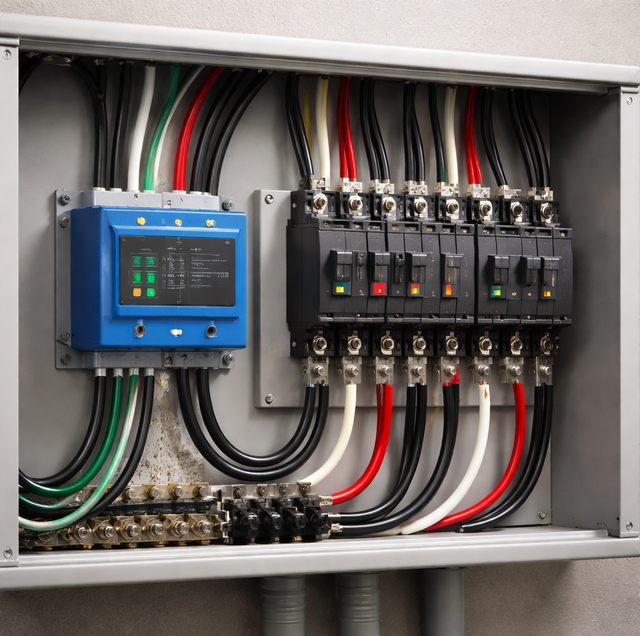
Quick Answer: A whole-house surge protector, more precisely called a surge protective device (SPD), installs at your electrical panel. When a large voltage spike hits the incoming power, the SPD clamps it down and diverts the excess energy safely to ground before it can travel out to your circuits and damage what is connected to them.
A dishwasher control board that dies for no clear reason, a smart TV that suddenly loses its picture, an LED bulb that flickers and burns out months early. These small failures often trace back to something invisible: voltage spikes moving through the wiring. A whole-house surge protector is the device meant to stop those spikes before they reach the equipment plugged into your outlets.
What a Surge Actually Is
Your home runs on a steady voltage, nominally 120 volts on a standard circuit. A surge is a brief jump above that level, sometimes lasting only microseconds, but carrying enough extra energy to overwhelm the sensitive parts inside electronics and appliances. The spike does not need to be dramatic to cause harm. Many are small enough that you never notice a flicker, yet they chip away at circuit boards, capacitors, and control modules over time until something quits.
Electronics are more vulnerable than they used to be. Older appliances ran on simple mechanical switches and heavy iron coils that shrugged off minor spikes. Today a refrigerator, thermostat, or garage door opener has a microprocessor inside, and those low-voltage chips have little tolerance for a jolt of stray energy.
Where surges come from: People tend to blame lightning, and a nearby strike can certainly send a massive spike down utility lines. But direct-strike surges are the rare, headline-grabbing case. The far more common sources are quieter and happen all year:
- Utility switching: The power company routinely switches equipment on the grid, and reconnecting after an outage or shifting load between lines can send a spike into every home on the circuit.
- Internal surges from your own motors: This is the biggest and least understood source. Any large motor draws a burst of current when it starts and releases stored energy when it stops. An air conditioner compressor, a well pump, a refrigerator, a pool pump, and a laundry motor all cycle on and off many times a day, and each cycle can push a small surge back into your wiring.
Industry testing has generally found that most surge activity in a home originates inside the home from these motor loads, not from the utility or the sky. That is why surge protection is a year-round concern rather than a seasonal one. A first cold snap or a stormy stretch might raise the odds of an outside spike, but your own appliances are cycling and generating internal surges every day of the year regardless of the weather.
How a Panel SPD Clamps and Diverts the Spike
A surge protective device sits waiting and does nothing during normal operation. Electricity flows past it untouched. The moment voltage climbs above a set threshold, the device switches on in a fraction of a microsecond and opens a low-resistance path that shunts the excess energy to the grounding system. Once voltage drops back to normal, the SPD closes that path and returns to standby.
The internal component doing this work is usually a metal oxide varistor, a block of material that resists current at normal voltage but becomes highly conductive above its clamping point. A single strong surge, or the slow accumulation of many smaller ones, gradually wears the varistor down, which is why an SPD is a consumable part rather than a permanent fixture.
Type 1 versus Type 2: Panel-mounted SPDs come in two families, and the difference is mainly where they connect.
- Type 1 is rated to install on the line side of the main breaker, meaning it can sit ahead of the panel's main disconnect. It is built to handle the larger energy of an externally driven surge and is often the choice where utility-side events are a concern.
- Type 2 installs on the load side, inside the panel after the main breaker, and is the common residential choice. It handles the same everyday internal and utility surges and is simpler to fit into a typical service panel.
Both types do the same fundamental job of clamping and diverting. A licensed electrician chooses between them based on your service, your panel, and how the grounding is arranged.
Why Layering Beats a Single Device
A panel SPD is the first line of defense, but it is not the whole answer. It knocks a large spike down to a much lower level, yet a residual amount of energy can still slip past it onto the branch circuits. For a plasma TV or a gaming computer, even that reduced level is worth catching a second time.
The stronger approach is layered protection: the panel SPD handles the big diversion at the service entrance, and a quality point-of-use strip at the outlet cleans up whatever gets through and sits closest to your most sensitive gear. The panel device protects hardwired equipment that never touches a plug strip, like the furnace, the range, and the dishwasher, while the plug-in strips guard the electronics you can reach.
Think of it as a coarse filter followed by a fine one. The panel SPD stops the flood; the local strip catches the drips. Neither alone does what the pair does together.
Reading joules and clamping voltage: Two numbers describe a surge device. Joules measure how much total energy it can absorb over its life before it wears out; a higher joule rating generally means a longer service life and more headroom for big events. Clamping voltage is the level at which the device kicks in and starts diverting; a lower clamping voltage means it acts sooner and lets less energy through to your equipment. In plain terms, you want enough joules to survive years of daily spikes and a low enough clamping voltage that the leftover energy reaching your devices stays small.
What a Surge Protector Does Not Do
An SPD is narrow in what it handles, and it helps to know its limits.
- It does not replace grounding. The whole mechanism depends on a proper ground path to dump surge energy into. A surge device on a home with poor grounding cannot do its job, because there is nowhere for the diverted energy to go.
- It is not a battery backup. An SPD does nothing about a blackout, a brownout, or a voltage sag. It only reacts to spikes above normal. If you need equipment to keep running through an outage or ride out a dip, that is the role of an uninterruptible power supply, a UPS, with its own battery.
- It does not condition power. It will not smooth out flickering lights caused by a loose connection or fix ongoing voltage problems, which are separate issues an electrician diagnoses directly.
The Indicator Light and Knowing When It Is Spent
Because the device wears down with every surge it absorbs, that light is your only easy signal of its health. There is no fixed calendar for this. A home in an area with frequent utility events or a lot of heavy motor cycling wears its SPD faster than a quiet one. Checking the indicator a couple of times a year is a reasonable habit, and any electrician servicing your panel can glance at it during other work.
Most panel surge devices have a small status light, usually green, that confirms the internal components are still protecting. When the indicator turns off, changes color, or a labeled window shows a fault, the protective element is spent and the device needs replacement even though your power still works normally. Check the light a couple of times a year.
A whole-house surge protective device wires directly into the electrical panel, where the busbars carry lethal voltage that is present even when individual breakers are off. Opening a panel and landing conductors there is not a homeowner task. A licensed electrician de-energizes the service safely, mounts the device, and confirms the grounding it relies on is sound.
Frequently Asked Questions
Only if it is labeled as a surge protector, not a plain relocatable outlet. Many cheap strips are just multi-outlet extension cords with an on/off switch and no protective components inside. A true point-of-use surge strip lists a joule rating and a clamping voltage on the packaging. A strip that only adds outlets gives you convenience and zero surge protection, so check the label rather than assuming.
There is no set expiration date because lifespan depends on how many surges it absorbs, not on time. A device with a high joule rating in a home with few grid events may protect for a decade, while one taking constant hits from utility switching and heavy motors can wear out much sooner. The indicator light, not the calendar, tells you when it is done. This is different from the plug-in strips downstream, which should be replaced after any single large event you know about.
Yes, and it is often a smart move when a subpanel feeds sensitive or expensive equipment, such as a home office, a detached workshop, or a well system. Adding an SPD at the subpanel places protection closer to those loads and catches surges generated by motors on that panel before they spread. It supplements the main-panel device rather than replacing it.
Usually not, because flickering is rarely a surge problem. Persistent flicker more often points to a loose neutral connection, an overloaded circuit, or a large motor briefly dragging voltage down when it starts. An SPD only reacts to voltage going too high, not to sags or dips that dim lights. Ongoing flicker is worth having an electrician trace, since a loose connection can be a fire risk.
A Type 2 device is typically connected through a dedicated two-pole breaker in the panel, which gives it a clean connection and a way to disconnect it for replacement. The breaker is not there to trip on a surge, since the device reacts far faster than any breaker can. It exists to isolate the SPD for safe servicing and to protect the wiring feeding it.
They can, but the arrangement needs an electrician's attention. A home with rooftop solar has an inverter and extra connection points that also benefit from surge protection, and a generator transfer switch changes where a Type 1 or Type 2 device should sit. The protective principle is the same; the placement and the number of devices change with the equipment, which is why these setups are evaluated case by case.
Ask about a panel surge assessment — a licensed electrician can add whole-house protection and verify your grounding is ready for it. Zimmerman Electric serves Surprise, Sun City, and the West Valley. Call (602) 497-3365.
