
Are My Outlets Grounded? 5 Warning Signs to Check
Quick Answer: A properly grounded outlet has a third slot (the round hole) wired to a real ground path back to your panel. You can check most outlets in seconds with an inexpensive plug-in receptacle tester: its lights show whether the ground, hot, and neutral are all present and correctly connected. If the tester flags an open ground, or if an outlet has only two slots, the circuit needs an electrician to confirm and correct the wiring.
Grounding is one of those things that sits quietly behind your walls doing nothing at all, right up until the moment it does everything. Most days, the ground wire in a circuit carries no current. It is a spare lane held in reserve. But when a hot wire slips loose inside an appliance and touches the metal case, or a nick in the insulation lets current stray where it should not, that reserved lane suddenly has a job. A working ground gives fault current a fast, low-resistance route straight back to your electrical panel. That surge of current trips the breaker in a fraction of a second, cutting power before the metal case of your toaster, washer, or power tool can become live.
Without that path, the fault has nowhere safe to go. The appliance case can sit energized and silent, waiting for a hand to complete the circuit. That is the whole reason grounding exists, and it is why an outlet that only looks finished can still be a hazard.
What Grounding Actually Does
Every standard circuit in a modern home runs three conductors: a hot wire that delivers power, a neutral that carries it back, and a ground that normally does nothing. The ground connects the metal parts of your devices and the round third slot of your outlets to a common point at the panel and ultimately to the earth.
Think of the ground wire the way you would a fire exit in a crowded building. Nobody uses it on an ordinary day, and it can feel like wasted space. Its entire value is realized in the one emergency when the normal doors are blocked, and everyone needs out at once. Fault current behaves the same way: given a proper ground, it rushes out the emergency exit and trips the breaker. Denied one, it looks for any other route, and sometimes that route is a person.
An ungrounded outlet does not announce itself. The lamp still lights, the phone still charges, the TV still turns on. The protection that is missing only matters during a fault, which is exactly when you cannot afford for it to be absent.
The Clues That an Outlet May Not Be Grounded
You can spot several warning signs without any tools at all, just by looking and knowing what older wiring tends to hide.
Two-slot outlets: An outlet with only two slots and no round hole beneath them has no ground connection at the receptacle. These were standard in homes wired before grounded outlets became the norm, and they are an honest signal: no third slot means no equipment ground at that point.
Three-slot outlets in an older home: This is the trickier case. A three-slot outlet looks grounded because it has the round hole, but in an older home someone may have simply swapped an old two-slot receptacle for a modern three-slot one without running a ground wire back to the panel. The outlet now accepts a three-prong plug, yet the ground slot connects to nothing. It looks safe and is not.
Adapters and clues at the plug: Cheater plugs, the little gray adapters that convert a three-prong cord to fit a two-slot outlet, are a strong hint that the original wiring was never grounded. So is a house of a certain age that has never had its wiring updated. None of these confirm the problem on their own, which is why the next step is a simple test.
How a Plug-In Receptacle Tester Works
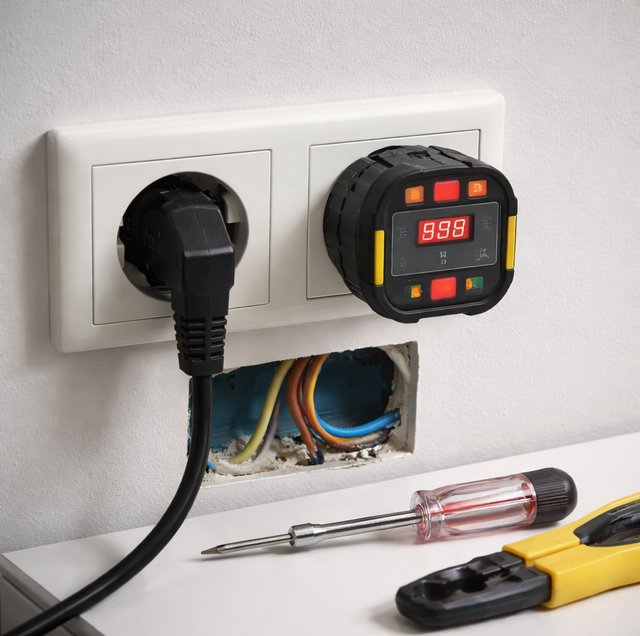
A plug-in receptacle tester, sometimes called an outlet tester, is a small three-prong block with two or three indicator lights on top. It costs very little, it is safe for a homeowner to use, and it does its job the moment you push it into the outlet. No cover comes off, no wire is touched, nothing gets opened.
Inside, the tester checks the voltage relationships between the three slots: hot, neutral, and ground. Depending on which lights glow and which stay dark, it reports a specific condition. Every tester prints its own legend on the body, but the common patterns are consistent:
Reading the lights
- Two amber lights (or the pattern the legend marks "correct"): hot, neutral, and ground are all present and wired in their proper places.
- A single light with the ground position dark: an open ground. The outlet has power, but the ground slot connects to nothing usable. This is the classic false-ground result.
- Reversed hot and neutral, or an open hot: other wiring faults the tester will flag with their own light patterns, all of which mean the outlet needs a professional look.
A plug-in receptacle tester is an inexpensive block you push into an outlet, and its indicator lights report whether hot, neutral, and ground are all present and correctly wired. It is safe for a homeowner to use since nothing gets opened. Walk the house, test each outlet in about two seconds, and note any that do not read correctly.
The False-Ground Problem
The most deceptive result is the false ground: a three-slot outlet that accepts your plug, powers your device, and yet has no real ground behind it. This is what an open-ground reading on the tester reveals.
The danger here is misplaced confidence. A surge protector plugged into a false ground cannot shunt a surge to a ground that is not there, so it quietly stops protecting your electronics.
A false ground is deceptive. A metal-cased appliance plugged into a three-slot outlet with no real ground behind it has no path to trip the breaker during an internal fault, so its case can go live exactly as it would in an old two-slot outlet, except nothing warns you. A surge protector on that outlet also quietly stops protecting your electronics.
Why a GFCI Is Protection but Not a Ground
There is one legitimate way to make an ungrounded outlet safer without running a new ground wire, and it is worth understanding precisely because it is easy to misread.
A GFCI, the outlet or breaker with the "test" and "reset" buttons, watches the current flowing out on the hot and back on the neutral. In a healthy circuit, those two match. If even a small amount of current goes missing, meaning it is leaking somewhere it should not, such as through a person, the GFCI cuts power in milliseconds. It does this by comparing hot and neutral directly, so it does not need a ground wire to work.
That makes a GFCI a valid safety upgrade for an ungrounded circuit. It protects the person. What it does not do is create a ground. Surge protection still has no ground to use, and equipment that relies on a grounded case still lacks that path. Because the outlet is protected but not grounded, an electrician who installs a GFCI on such a circuit is expected to label the downstream outlets accordingly, so the next person knows the receptacle is guarded against shock but is still not a true grounded outlet. The label is not decoration. It is the honest disclosure that keeps a future homeowner from trusting a ground that does not exist.
Why Correcting Grounding Is an Electrician's Job
A plug-in tester is a homeowner's tool, and it is where your part sensibly ends. It can tell you an outlet reads wrong. It cannot tell you why, and it cannot fix it.
The reason a tester is not the final word is that it checks only what it can see from the face of the outlet. It cannot detect a ground wire that is connected but corroded, a bootleg ground where someone jumpered the ground slot to the neutral to fool a tester, or a break in the ground path deep in the run. Some of those faults pass a plug-in test and still fail you in an emergency. Confirming a real, continuous ground calls for measurement and inspection that a licensed electrician performs.
Correcting the problem is licensed work by nature. Depending on the situation, the fix might mean running a new ground conductor, replacing outdated cable, correcting a mis-wired receptacle, or installing labeled GFCI protection where a full rewire is not practical. All of it involves the wiring behind the wall, which is precisely where a homeowner should not go. Use the tester to find the questions. Hand the answers to a pro.
Frequently Asked Questions
Yes, and it gives a fuller picture, but it takes more care. Set to AC voltage, you should read roughly 120 volts between hot and neutral and about the same between hot and ground on a correctly grounded outlet. A near-zero reading between hot and ground while hot-to-neutral reads normal points to a missing or open ground. A multimeter can also expose a bootleg ground that fools a simple light tester, because the voltage relationships shift in ways the three-light block cannot distinguish.
Current residential wiring standards call for tamper-resistant receptacles in living spaces, which have internal spring-loaded shutters that stay closed unless both slots are pressed at once, blocking a child from inserting a single object. Grounding and tamper resistance are separate features: a receptacle can be one, both, or neither, so a tamper-resistant outlet is not automatically a grounded one.
Physically, it plugs in and the device powers on, because the hot and neutral still function normally. The ground pin simply lands on a dead slot. So the appliance runs while its safety ground does nothing, which is the quiet trap: everyday operation gives you no signal that the protective path is missing.
Ground connections can loosen from decades of thermal cycling, corrode where dissimilar metals meet in damp areas, or break where rodents have chewed cable in an attic or crawlspace. A circuit that tested correct when the house was built can develop an open ground years later, which is why a periodic recheck matters even in newer construction.
Not by itself. Two-slot outlets were the accepted standard for their era and can operate safely for double-insulated devices, which are built with plastic bodies and no exposed metal to energize, and are marked with a square-within-a-square symbol. The concern arises when metal-cased equipment or surge-sensitive electronics get plugged into an ungrounded point, so the fix is often prioritized by what you plug in where.
They face harsher exposure, so their ground paths corrode faster and are worth checking first. Receptacles in wet or damp locations are also expected to carry weather-resistant ratings and in-use covers that stay protective while a cord is plugged in, features unrelated to grounding but easy to confuse with it during a walkthrough. Testing them on the same pass as your indoor outlets keeps the most exposed points from being the ones you skip.
Book a grounding and outlet safety check — get a clear answer on every receptacle in your home before a hidden fault finds you. Zimmerman Electric Company serves Surprise, Sun City, and Peoria. Call (602) 497-3365.
