
What Is an AFCI Breaker and Why It Matters for Fire Safety
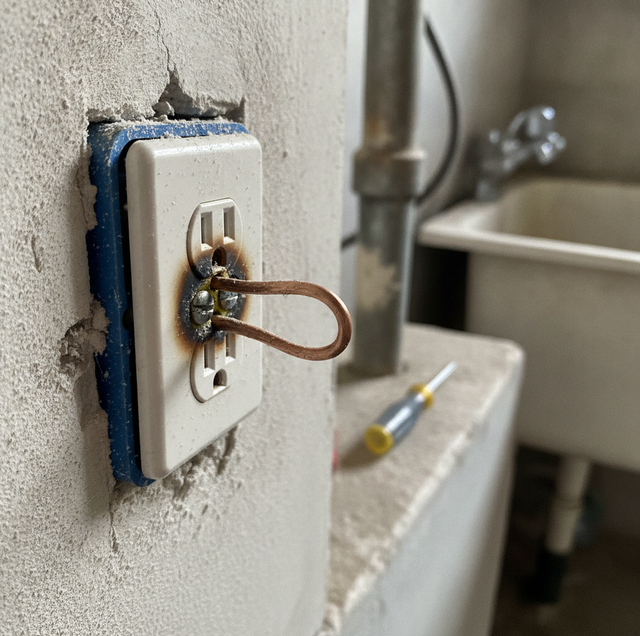
Quick Answer: An AFCI, or arc-fault circuit interrupter, is a breaker (or sometimes an outlet) that watches for the specific electrical signature of arcing, the tiny high-heat sparks that jump across a loose connection or a damaged wire and can ignite whatever is nearby. A standard breaker only reacts to overload or a dead short, and never notices an arc; a GFCI watches for current leaking to ground to protect a person from shock. The AFCI covers the third danger: fire. If one trips again and again, it is usually catching a real fault, and the fix is to find the fault, not to swap in a plain breaker.
Open your electrical panel, and most of the breakers look identical: a row of switches, each protecting a circuit. But some of them are doing a job that the plain ones cannot. They are listening, thousands of times a second, for a very particular kind of electrical trouble, one that a normal breaker will happily ignore right up until the wall catches fire. That breaker is an AFCI, and understanding what it watches for explains why newer homes have them and why a repeated trip is worth paying attention to.
What an AFCI Breaker Actually Does
AFCI stands for arc-fault circuit interrupter. Its whole purpose is to detect dangerous electrical arcing on a circuit and shut that circuit off before the arc can start a fire. It does this by monitoring the current on the wire and analyzing the shape of the waveform, looking for the erratic, jagged pattern that arcing produces. Ordinary current flows smoothly. An arc chops and stutters. The breaker's electronics are tuned to recognize that stutter, tell it apart from the normal noise a house makes, and cut power when it sees the real thing.
Some of these devices are built into a breaker at the panel, which protects the entire circuit from the panel to the last outlet on the run. Others are built into an outlet, protecting everything downstream of that point. Either way, the function is the same: catch the arc, drop the power.
What an Electrical Arc Is, and Why It Starts Fires
An arc is electricity jumping a gap. When two conductors that should be touching are instead separated by a hair, current can leap across the space between them rather than flowing through solid metal. That jump is not a clean connection. It is a rapid, sputtering spark, and the air in the gap resists it, which concentrates a large amount of energy into a very small space. The result is heat, an enormous amount of it in a spot the size of a pinhead.
There are plenty of ordinary ways for that gap to open up inside a wall or a device:
A loose connection: A screw terminal that was never fully tightened, or one that worked loose over the years of the wire heating and cooling, leaves a wire barely making contact. Current arcs across the tiny gap every time the circuit draws a load.
A damaged or pinched wire: A cable stapled too tightly, crushed by a screw, or bent sharply against a sharp edge can have crushed or nicked conductors that arc internally.
A nail or screw through a cable: A picture hanger or a drywall screw driven into a hidden cable can nick the conductor without cutting power, leaving a slow arc buried in the wall.
A cracked or frayed cord: Lamp cords pinched under furniture, extension cords run under rugs, and appliance cords flexed at the plug thousands of times develop breaks in the copper that arc under the insulation.
Worn or degraded insulation: Old wiring, or wiring baked by years of heat, can lose the insulation that keeps conductors apart, letting them arc where they touch.
Here is the part that makes arcing so dangerous. A normal breaker sizes itself according to the total current on the circuit. It trips when the circuit pulls more amps than it is rated for, an overload, or when a hot wire touches a neutral or ground directly and current spikes, a short. An arc does neither. The overall current on the circuit can stay completely normal while a pinpoint of the wire is running hot enough to char wood, ignite insulation, or set dust and lint smoldering inside a box. The plain breaker sees nothing wrong because, by its measure, nothing is. The AFCI sees the arc's signature and acts.
How an AFCI Is Different From a GFCI and a Standard Breaker
The panel can hold three kinds of protection, and they guard against three different dangers. Confusing them is common, so it helps to line them up.
A standard breaker protects the wiring itself. It watches the amount of current and trips on too much of it, either a sustained overload or a sudden short. Its job is to keep the wires from overheating along their whole length. It says nothing about arcing or about current leaking off the circuit.
A GFCI, ground-fault circuit interrupter, protects people from shock. It monitors whether all the current that leaves the hot wire returns on the neutral. If a few thousandths of an amp go missing, meaning current found another path to ground, possibly through a person, it cuts power in a fraction of a second. That is why GFCIs live in bathrooms, kitchens, garages, and outdoors, where water and hands meet electricity.
An AFCI protects against fire from arcing. It ignores overload (the breaker's job) and ignores small leaks to ground (the GFCI's job) and instead studies the waveform for the chaotic pattern of a spark jumping a gap.
One way to hold the three apart: the standard breaker protects the wire, the GFCI protects the person, and the AFCI protects the building. Different sensors, different thresholds, different failures caught. That is also why many homes carry all three kinds, and why a single circuit sometimes needs more than one type of protection at once.
Where AFCI Protection Is Used
AFCI requirements have expanded steadily as the technology matured and its fire-prevention record grew. In newer construction and in updated panels, arc-fault protection is now called for on a wide range of living-space circuits, bedrooms, living rooms, family rooms, dens, hallways, and similar areas where people spend time and where lamp cords, extension cords, and hidden wiring create the loose-connection and cord-damage risks that arcing feeds on.
The logic behind the requirement is simple: the rooms people sleep and relax in are exactly the rooms where an undetected arc smoldering behind a wall or under a couch has the most time to grow before anyone notices. Bedrooms drew the earliest requirement for that reason. If your home is older, its bedroom and living-area circuits may not have this protection at all, which is one of the things an electrician checks when evaluating an aging panel.
Why an AFCI Trips, and Why That Matters
AFCIs occasionally trip when nothing is actually wrong. The electronics are listening for a jagged, arc-like waveform, and a few appliances produce electrical noise that can resemble one, such as certain motors, some dimmers, and various electronic devices among them. This is nuisance tripping, and it is a real limitation of the technology.
But the reflex to blame the breaker is a trap. Far more often, a breaker that trips repeatedly is catching exactly what it was installed to catch: a genuine developing fault. A screw terminal that has worked loose. A cord was crushed behind a dresser. A cable nicked by a screw during a long-ago remodel. When the AFCI keeps dropping the circuit, it is frequently pointing straight at a real arcing connection that is heating up somewhere in the walls or the devices on that run.
That is why the response matters so much. A persistent AFCI trip should be investigated, not ignored, and not defeated. The temptation to make the tripping stop by swapping the AFCI for an ordinary breaker removes the one device that can see the fault, and hides a possible fire hazard instead of fixing it. The right move is to have an electrician trace the circuit, find the loose or damaged connection, and correct it. Once the fault is gone, the breaker holds.
There is also a TEST button on every AFCI, on the breaker face or the outlet. Pressing it simulates an arc so the device can prove it still trips and cuts power. Testing periodically confirms the protection is alive, because a protective device that has quietly failed gives no warning until the moment you need it, and it is not there.
Dual-Function Breakers
Some circuits need both arc-fault and ground-fault protection, and manufacturers make a single device that provides both. It is called a dual-function, or combination, breaker, and it delivers AFCI and GFCI protection in one unit. That means one breaker covers both the fire risk from arcing and the shock risk from a ground fault, which is convenient where a circuit falls under both requirements, a kitchen or laundry area, for instance, that also serves living space. To the homeowner, it looks like one more breaker in the panel, but it is doing two separate safety jobs.
Why This Is a Licensed-Electrician Job
Everything an AFCI does happens at the panel, and the panel is the one place in a home where the incoming service is present, even with the main breaker off in some configurations. Installing or replacing a breaker means working inside an energized enclosure, matching the breaker to the panel's make and bus design, and landing the neutral and load connections correctly, because AFCI breakers wire differently from plain ones. Getting any of that wrong can create the exact loose connection the breaker is supposed to prevent, or leave the protection non-functional.
For that reason, panel work is a job for a licensed electrician, not a weekend project. The same goes for chasing down what a stubborn AFCI is catching: finding a buried arcing fault means safely opening boxes, testing connections, and reading what the circuit is telling you. If an AFCI in your panel keeps tripping, the safe and correct path is to have it diagnosed rather than reset one more time or replaced with a breaker that cannot see the danger.
Frequently Asked Questions
An arc is electricity jumping a small gap, and it comes in two named forms. A series arc happens at a single loose connection along one conductor, such as a wire barely held by a slack screw terminal. A parallel arc jumps between two conductors, the classic case being a nail or screw driven through a cable. A combination AFCI is built to catch both. Either kind produces a spark hot enough to ignite framing, insulation, or dust, and the danger is that a normal breaker never sees it: overall current stays normal while that pinpoint spark runs hot enough to start a fire.
A GFCI watches for current leaking off the circuit to ground and trips at roughly 4 to 6 milliamps of leakage, a threshold set to protect a person from shock. An AFCI never uses that threshold because it is not measuring leakage at all; it is watching the shape of the current waveform for the erratic signature of arcing, and its job is to prevent a fire. They guard against two entirely different dangers, which is why they are not interchangeable and why many homes use both, sometimes on the same circuit.
It can trip on electrical noise from some motors or electronic devices, which is nuisance tripping. One specific wiring mistake causes a lot of these: a shared neutral on a multi-wire branch circuit, where two circuits share one neutral wire. A miswired shared neutral confuses the AFCI's sensing, so it is one of the first things an electrician checks on a repeat trip. Past that, a breaker that trips again and again usually means a real fault, a loose connection, or a damaged wire arcing on the circuit, and it should be traced rather than blamed on the breaker.
No. Doing that removes the arc-fault protection the circuit is supposed to have, and it hides a possible wiring fault instead of fixing it. If the AFCI was tripping because of a real arcing connection, that fault is still there after the swap, only now, nothing is watching for it. There is a second cost people miss: where the protection is required, removing it can surface later as a problem on a home-sale inspection or with an insurer, so it is more than a safety loss. An electrician finds and corrects the cause rather than defeating the device.
It is a single breaker that provides both arc-fault and ground-fault protection at once, covering the fire risk from arcing and the shock risk from a ground fault in one device. Worth noting is that "combination" also describes the arc-detection itself: older branch/feeder AFCIs caught only parallel arcs, while today's combination-type AFCIs add series-arc detection for loose single connections too. That is why the type stamped on the breaker face matters, and why an older AFCI is not equivalent to a current one.
Press the TEST button with the power on; the breaker should trip, and you then reset it afterward. A monthly test is the common recommendation, because a protective device that has failed silently gives no warning at all. You find out it is dead only in the moment you were counting on it. The button simulates an arc so the device can prove it still trips, which is the only way to confirm the electronics inside are still alive.
Have an electrician check your panel and arc-fault protection — know your circuits are actually guarding against fire. Zimmerman Electric Company serves Surprise, Sun City, and Peoria. Call (602) 497-3365.
