
Garage Power Upgrades for Tools, EV Chargers, and More
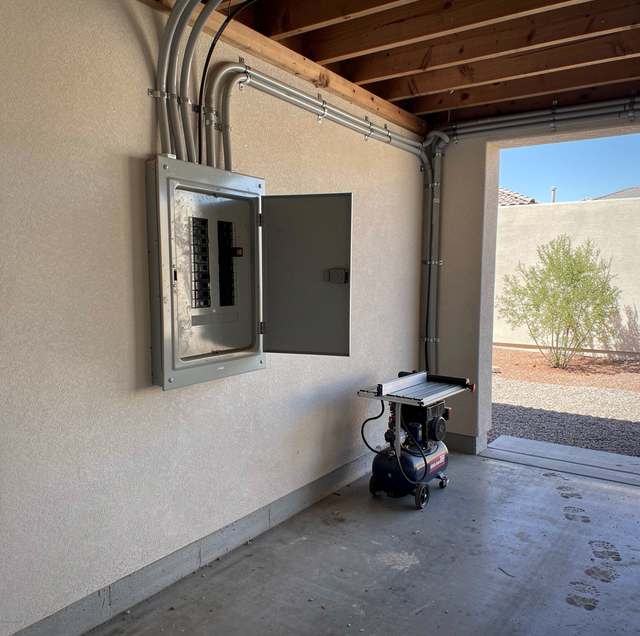
Most garages were wired decades ago for a light fixture, a garage door opener, and maybe one general-purpose outlet, never with the idea that the space would eventually hold a table saw, an air compressor, and an EV charger all pulling power the same evening. Adding any one of those to a garage's original wiring often works fine for a while and then starts tripping breakers, dimming lights, or simply not delivering enough power for the equipment to run at its rated output.
Why a Garage's Original Wiring Wasn't Built for This
A garage circuit installed with the rest of the house was usually intended for occasional light use: a bulb, a door opener, maybe a shop vac now and then. It was rarely sized for sustained heavy draw from motor-driven tools, compressors, welders, dust collectors, that pull several times their running amperage just at startup. That mismatch between what the circuit was built for and what's actually plugged in is the root of most garage electrical complaints.
Motor Loads vs. Continuous Loads
A motor, whether it's in an air compressor, a table saw, or a dust collector, draws a spike of current, several times its normal running amperage, for a fraction of a second the instant it starts. That locked-rotor inrush is why a circuit that handles a tool fine once it's running can still trip the moment you switch it on, especially if the circuit is already sized right at the edge of what it can carry.
An EV charger behaves completely differently. Instead of a brief spike, it draws a steady current for hours at a time, which is why chargers get their own dedicated circuit and are typically sized so the charger's continuous draw sits around 80 percent of the breaker's rating, not right up against it. In practice, that means a 40-amp breaker is generally paired with a charger set to draw about 32 amps continuously, and a 50-amp breaker with one set closer to 40 amps. A circuit that's technically "big enough" for a short burst of current isn't automatically big enough to run something at that steady percentage for six or eight hours straight without the wire and breaker running warmer than they should.
What Different Garage Equipment Actually Needs
| Equipment | Typical circuit type | Why |
|---|---|---|
| Hand tools, small chargers | Shared 15-20A general outlet | Light, intermittent draw |
| Air compressor, table saw | Dedicated 20A, sometimes 240V for larger shop compressors | High motor inrush needs headroom, or nuisance trips result |
| Home-shop welder | Dedicated 240V circuit sized to the welder's rating | Heavy, sustained draw unlike hand tools |
| Level 2 EV charger | Dedicated 240V circuit, often 40-50A | Continuous multi-hour draw at a steady rate |
| Mini-split or space heater | Dedicated circuit sized to the unit | Continuous load competing with other garage equipment |
What Limits How Much You Can Add
Beyond the garage's own wiring, the home's main panel has a finite number of open breaker slots and a total amperage rating. Adding a 50-amp EV charger circuit to a panel that's already running close to its rated capacity, between pool equipment, central air, and an electric dryer, can mean there isn't headroom left without either freeing up an existing circuit or upgrading the panel itself. That's why an electrician runs a load calculation, adding up the home's existing connected loads against the panel and service size, before recommending a new garage circuit, rather than assuming there's room simply because a breaker slot happens to be empty.
Capacity has one more layer above the panel: the utility transformer feeding your street is sized for a typical neighborhood's expected loads, not for several homes adding EV chargers and shop equipment in the same year. That's the exception rather than the rule for a single garage upgrade, but it's part of why a utility-side capacity conversation occasionally comes up on a block where several homes are electrifying at once.
Planning a Garage for Multiple Big Loads at Once
Once a garage needs three or more dedicated 240V circuits, running each one individually back to the main panel gets expensive and clutters the panel with garage-specific breakers. A small sub-panel installed in the garage itself can consolidate several of those circuits- EV charger, welder, compressor- onto one feed from the main panel, giving the garage its own local breaker access and making future additions simpler.
Matching the receptacle to the actual plug matters just as much as the circuit sizing. A NEMA 6-20 outlet suits many 240V compressors, while a NEMA 14-50 is common for EV chargers and welders. Using the correct receptacle type for the equipment's actual plug prevents someone from improvising with an adapter that isn't rated for the load it carries.
Signs Your Current Garage Wiring Is Already Maxed Out
A few patterns show up long before anything trips completely. Lights inside the garage or even in an adjacent room dimming for a second when a compressor or saw kicks on is voltage sagging under that motor's startup draw, a sign the circuit or the wire feeding it is working harder than it should. An outlet that feels warm to the touch after running a tool for a while, or a breaker that's noticeably harder to reset than others in the panel, points the same direction. None of these are emergencies on their own, but they're the wiring telling you it's near its limit well before it fails outright.
Wire Gauge and Conduit: What Actually Goes in the Wall
The breaker rating alone doesn't tell the whole story; the wire gauge feeding it has to match. A 40-amp circuit typically requires 8 AWG copper conductors, while a 50-amp run steps up to 6 AWG; undersizing either one means the wire can heat up under sustained load well before the breaker ever senses a problem. Garage runs are also commonly installed in EMT conduit with individual THHN conductors pulled through, rather than the NM-B sheathed cable used inside finished walls, since a garage's exposed studs and concrete surfaces make conduit both easier to run and more resistant to the kind of physical damage a garage sees from parked cars, stored tools, and ladders leaned against the wall.
Garage receptacles themselves are also typically installed with GFCI protection given the damp, concrete-floor environment a garage represents; a wet or grounded floor makes a ground-fault shock far more likely than in a carpeted living room. A dedicated 240V circuit for a welder or EV charger is usually the one exception, since that equipment's design and how it's hardwired or plugged in change how ground-fault protection is applied to that specific circuit.
Frequently Asked Questions
No. EV chargers are installed on their own dedicated circuit specifically because of their multi-hour continuous draw. Sharing with a compressor or welder risks tripping the charger's breaker mid-session, and some chargers log it as a fault that requires a manual reset before charging resumes.
No, and two circuits that both read 240V on a meter can still be built to completely different standards behind the wall. One might run on 12-gauge wire behind a 20A breaker, another on 6-gauge wire behind a 50A breaker, and a meter reading at the outlet won't show you which. The panel directory, or the amperage printed right on the breaker itself, is the only reliable way to confirm what an existing 240V circuit can actually carry before connecting anything new to it.
Locked-rotor inrush current lasts a fraction of a second at startup, so whether it trips can depend on what else is drawing power on that circuit at that exact moment. A compressor that starts fine when the garage is otherwise quiet can trip if a space heater or another motor is running at the same time.
It depends on what the main panel has room for, as much as how many circuits the garage needs. A sub-panel still needs its own dedicated feed breaker back at the main panel, sized to carry everything downstream of it, so if the main panel is already tight on open slots or amperage, a sub-panel doesn't remove that constraint; it just relocates where the shortage shows up. Where the main panel has capacity to spare, running individual circuits usually stays the simpler and cheaper path even with two or three dedicated garage loads.
Not safely. The wire feeding an existing outlet is sized for that outlet's original amperage, so increasing only the breaker size without upgrading the wire creates a mismatch where the wire can overheat well before the larger breaker ever trips.
Yes. The sub-panel's total capacity counts against the main panel's load calculation, just like any other circuit. The main panel's directory should be updated to show what the sub-panel feeds, so a future electrician working on the home sees the full picture instead of an unlabeled feed.
Most garage electrical problems don't stem from a single badly sized circuit. They come from a compressor added one year ago, a welder the next, and an EV charger after that, each installed on its own timeline, with nobody stepping back to look at the panel as a whole. A load calculation done once, before the next big addition goes in, costs far less than pulling new wire a second time because the first pass didn't account for what was coming.
Adding a compressor, welder, or EV charger to your garage — get the circuit sized right the first time. Zimmerman Electric Company serves Surprise, Sun City, and Peoria. Call (602) 497-3365.
