
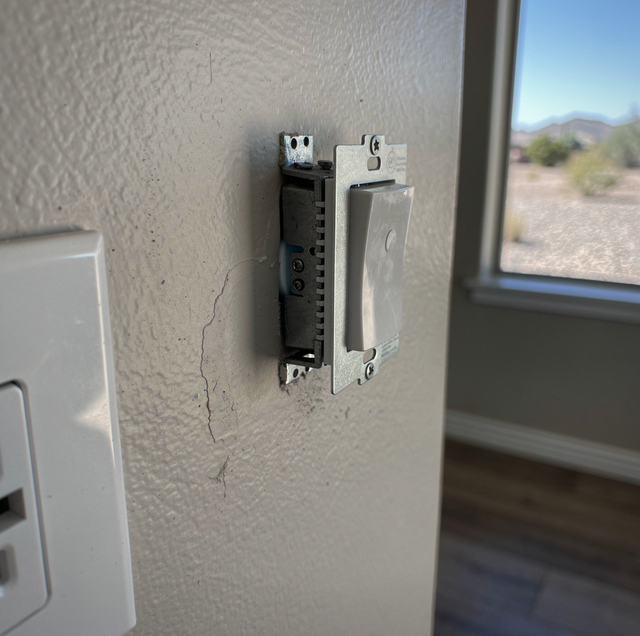
A dimmer switch is built to make some heat. To lower the light, it holds back part of every half of the alternating-current cycle and lets the rest through to the lamps, and the electronic part doing that switching loses a small share of the power it passes as heat. The dimmer sheds heat through metal fins on its sides and through its face, so a faceplate that feels mildly warm while the lights are on indicates the dimmer is working as built. Whether the warmth under your hand is normal turns on three things: how warm it gets, where the warmth sits, and what comes along with it. A mild, even warmth across the face of a dimmer that is running its lights is one case. Heat you cannot keep a hand against, warmth with the lights switched off, or warmth joined by a smell, a mark, or a crackle is another, and those call for the breaker and an electrician.
Heat Patterns at a Glance
Each pattern of warmth carries its own likely causes and its own level of urgency.
| What you notice | What it can mean | Call-now sign? |
|---|---|---|
| Faceplate mildly and evenly warm while the lights are on, at any setting | Normal operating heat from the dimmer's electronics | No |
| Warm only where several dimmers share one wide box and plate | Heat from ganged dimmers crowded together, or with their side fins removed, collecting in one space | Not by itself; worth an electrician's look when it is new |
| Hot to hold, or hotter than it used to be | A load above the dimmer's rating, or a connection beginning to fail | Yes: breaker off, and it stays off |
| Warm with buzzing or flicker | A dimmer not matched to the lamp type | Soon, and at once if the heat keeps climbing |
| Warm with a smell, discoloration or a crackling sound | A loose or failing connection | Yes: breaker off, it stays off, electrician now |
| Warm with the lights off | A failing dimmer or a wiring fault in the box | Yes: breaker off, then an electrician |
Where Dimmer Heat Comes From
One kind of household dimmer lowers light by timing. On each half of the alternating-current cycle it waits, then switches the current on for the remainder of that half, and the later it switches on, the less energy reaches the lamps. The part doing this is a semiconductor switch, and it is not a perfect conductor when it is on: a small voltage drop occurs across it as current flows, and that loss is dissipated as heat inside the dimmer. A small coil inside the dimmer, there to smooth the sharp switching edges and hold down electrical noise, adds a little heat of its own.
That heat has to go somewhere. On dimmers built with them, the metal fins on either side of the mounting strap act as a heat sink, drawing heat away from the switching component and spreading it over a larger surface area. From there it moves into the air of the wall box, into the faceplate and into the wall around it. The warmth on the plate is heat that has already traveled out along that path.
A wall box is a closed space, packed with conductors, connectors, and the back of the dimmer, and its open side is the face and the plate. Anything that crowds that space or cuts into the fins leaves the same heat with less room to escape, and anything that adds heat of its own, such as a second dimmer or a failing splice, adds to it.
Load Ratings and Ganged Boxes
Every dimmer carries a load rating, printed on the device itself and on its packaging, indicating the type of lamps it runs. The load is the total of all the lamps the dimmer controls. The more load a dimmer carries, the more current flows through its switching part and the more heat that part makes, up to the amount its fins and body were designed to shed at the full rating. A dimmer inside its rating, with its fins intact and a box to itself, runs warm and stays there. A dimmer rated higher than its load draws more heat than its fins and body were built to shed, and that heat builds up in the switching part and the plastic around it.
Reading the rating on an installed dimmer means removing the faceplate, which puts fingers near live terminals, so that step is for an electrician. The lamp side of the sum is easier to reach.
Wattage is printed on each bulb's base or glass (the bulb's own wattage, not the 'equivalent' figure), readable with the breaker off and the lamp cool. Every fixture on that dimmer counts toward the total, including recessed lights across the room.
The same dimmer can be comfortable in one box and too warm in another, and ganging is the reason. Installed alone in a single-gang box, a dimmer has its full fins and a box of air to itself. Set side by side with other dimmers in one wide box, it has neighbors adding their heat to the same space and a single plate collecting it from all of them. Finned dimmers fit side by side once the fins on the facing sides are broken off, and less fin means less metal carrying heat away. For that reason, a dimmer with fins removed for ganging carries a lower allowed load, and that reduced figure is the one that applies in a crowded box.
A warm multi-gang plate can be normal: two or three dimmers, each within its reduced rating, will warm a shared plate more than one dimmer alone. A multi-gang plate that turns hot, or one dimmer in the row noticeably hotter than its neighbors, is another matter. Breaking off more fins to squeeze a device in, or swapping a higher-rated dimmer into the box without checking the lamps, the lamp type and the box, is not a fix for either case.
Matching the Dimmer to the Lamps
A dimmer is built for particular lamp types, and the rating printed on it names them. When the lamps and the dimmer are mismatched, the dimmer can buzz, flicker or run warmer than it should, and the lamp swap that changed the pairing is the first thing to look at. Flicker has causes well beyond the dimmer, and a flicker that spreads past one dimmed circuit is a wiring matter rather than a dimmer one.
Connection Faults and When Warmth Becomes a Hazard
Dimmers connect to the house wiring through their own wire leads joined to the circuit conductors with twist-on connectors, or through screw terminals on the device. A connection that has loosened has less metal in contact, current crowds through the smaller contact area, resistance at that spot rises and the spot heats. That heat is outside the dimmer's design. No fin is built to carry it away, and each on-and-off cycle that warms and cools the joint can loosen it further.
Connection heat reads differently from operating heat. Operating heat spreads evenly across the face while the lights are on. Connection heat can sit at one edge or one corner of the plate, climb over time rather than hold steady, discolor the plate or the wall beside it, or come with a faint crackle or sizzle, which is the sound of current arcing across a gap. A burning or hot-plastic smell from the plate is an emergency of its own, and the breaker goes off at once.
Warmth with the lights switched off belongs in the same group. A dimmer that is off passes no current to its lamps and makes no load heat, so warmth at that moment comes from somewhere else. A switch box can hold splices carrying power onward to other lights or outlets, and a loose one warms the box whether the dimmed lamps are on or not. A dimmer failing inside can also leak current through a damaged switching part, which can leave the lights glowing faintly when they should be dark.
Where any of these signs shows up, the order is fixed. The dimmer's circuit is shut off at the breaker first and left off. Nothing else comes before it, and a dimmer that is too hot to hold, discolored, crackling or smelling of burning is not switched back on to test whether it still works. The faceplate stays on and the dimmer stays in the box.
A dimmer that has discolored, crackled or overheated can hide a scorched splice or loose terminal live behind its plate, and pulling it out puts hands on that damage. An electrician opens it with the breaker off and each conductor tested dead.
How an Overheating Dimmer Gets Fixed
The repair follows the cause, and troubleshooting comes first: the load on the dimmer, the lamp type, the box and each connection are checked with the circuit dead.
Replacing the dimmer: A dimmer that has overheated can be damaged inside even when it still works, and one that has discolored or scorched is replaced. The new one is chosen for the lamps it will run and rated for that load, including any reduced rating where it shares a box with other dimmers.
Correcting the box and connections: Loose connections are remade on clean, undamaged conductor, with any scorched or brittle ends cut back. Where a multi-gang box is too crowded for the devices it holds to shed their heat, the box itself becomes part of the repair.
Splitting the load: When one dimmer runs more lamps than any suitable dimmer can carry in that spot, part of the lamps can move to a second dimmer or switch, so each device carries a share inside its rating.
Swapping in an identical dimmer on an overloaded run repeats the problem, since the new part meets the same load in the same crowded box, and that is why the load and the box are checked before any device goes in.
Frequently Asked Questions
No. A plain on-off switch without a lighted toggle has no electronics inside; its contacts close metal to metal and have no built-in source of heat. Warmth you can feel at a plain switch has no design reason behind it, so it belongs with the connection faults and gets the same breaker-off treatment.
Not a modern electronic dimmer. Its heat follows the current flowing through it, and turning the lights down cuts that current, so it runs warmest near full brightness. Old rheostat dimmers worked the other way: they burned off the power they held back as heat, and they ran hot at dimmed settings.
Metal conducts heat and plastic insulates, so a metal plate over a dimmer can feel warmer than a plastic plate at the same temperature. The difference comes from the plate material rather than from extra heat in the dimmer, which is worth remembering after swapping plastic plates for metal ones.
Not from the heat. A breaker responds to current on the circuit, sized to protect the circuit's wire, and has no way to sense the temperature inside a device. A dimmer loaded past its own rating can still draw far less than the breaker's trip point, so it can run too hot with the breaker never moving. An arc-fault breaker, where the circuit has one, can trip on arcing at a loose connection, which is a separate signal from heat.
They can. Some dimmers print two ratings, a higher one for incandescent and halogen lamps and a lower one for LED and CFL lamps, because the electronics inside those bulbs load a dimmer differently from a filament. A room of LED bulbs is measured against the lower number, and a dimmer with no LED rating printed on it was not built with them in mind.
No. A lighting dimmer is built for lamps, and a fan motor on one can hum, run rough and overheat the motor or the dimmer. Fan speed is set by a control made for motors, and a fan with a light kit can have its light on a dimmer and its motor on a fan control, sometimes housed in a single combination device.
Hire dimmer switch replacement and troubleshooting — load and lamp-type matching, box connections, and a replacement dimmer rated for the lights it runs. Zimmerman Electric Company serves Surprise, Sun City, Peoria. Call (602) 497-3365.