
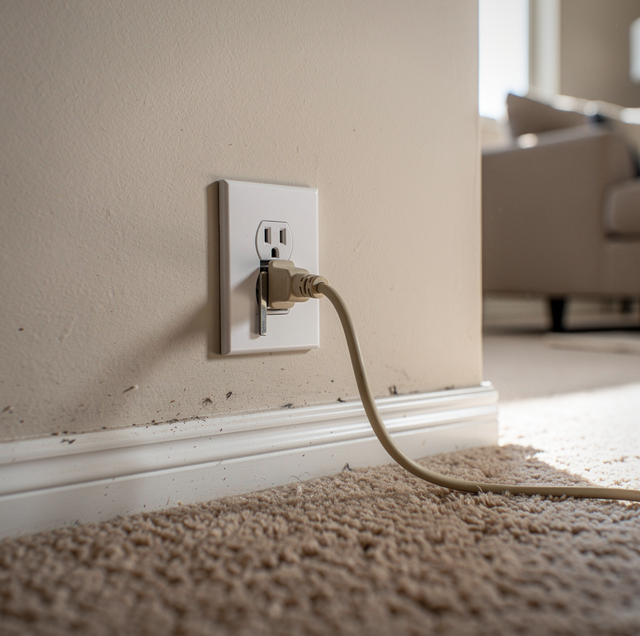
Push a lamp plug into the receptacle behind your sofa and feel the short resistance the blades meet just before they seat home. Small shutters inside the device swing clear as that happens, and they are the only piece of childproofing in the room that sits behind the wall rather than in front of it. Receptacles sit low, at the height a crawling child travels past, so a slot down there is among the first openings a curious hand finds. The things sold to close that opening are not equivalent to one another, and they do not give way in the same place. Knowing which of them is already on your wall changes what the rest are for.
The Outlet a Child Meets First
Behind the face of a receptacle sit two energized contacts, and the slots are the only route to them from the room side. The cover plate closes the gap around the device, not the openings in it. So the openings in that plate are the thing to deal with, and they sit at the height a child spends the day at.
What gets fitted to your outlets sits at one of two depths, and that depth separates them. The shutters came with the device and live behind its face, where nobody has to think about them again. A plate with a sliding cover and a push-in cap both sit in front of the face because you put them there.
That difference matters because the hazard has one shape. A thin conductive object entering a slot can reach a live contact, and everything sold for your outlets addresses that one route and then stops short somewhere. The place it stops short is different for each of them.
How Is an Object Kept Out of a Live Slot?
The mechanism is simple. A tamper-resistant receptacle features a built-in safety shutter system that blocks foreign objects from entering the receptacle openings, and the shutters open only when a two-bladed plug presses against both shutters simultaneously. Push something into one side on its own, and you move nothing at all.
Simultaneity is the whole of the trick. A single object, whatever its shape, arrives at one shutter, and that shutter, under pressure, stays where it is. A plug is different because its body holds the blades at a fixed spacing, so they arrive together and with matched pressure; a grounding plug does the same. The device is built around that one difference between your plug and everything else a hand can hold.
The shutters are hardware. Specification data for residential tamper-resistant devices name an acetal moving part for the shutter assembly and list those devices as carrying a safety listing to the standard for receptacles. Behind the shutters, your device is an ordinary receptacle with the same slot pattern and brass contacts as any other.
The Two-Letter Mark on the Face
From across a room, a tamper-resistant receptacle and an ordinary one have the same outline and the same slot pattern under the same plate. The shutters sit behind the openings and out of sight, so the shape of the thing gives you nothing to work with. What separates the two is smaller than the shape. A "TR" mold mark on the device face, or "TR" etched onto the strap, remains visible in the finished installation, which is why it is applied there.
The second tell is in your hand. A plug entering a tamper-resistant device meets the shutters and needs a square, even push from you before it seats; an ordinary receptacle offers only the grip of its contacts. That tell is real, but it drifts, because an old device grips hard and a new one takes a plug easily. The letters do not drift.
Some devices spell "tamper resistant" out on the shoulder instead of using the TR mark, so a receptacle with no TR on its face may carry the words beside the slots.
What Stops a Child at a Push-In Cap?
Push-in caps work by occupying the slot. Their prongs sit where a plug's blades would sit, and while one is in place nothing else goes in. The block is real. It is also the whole of what a cap does.
The test is plain: outlet plugs are acceptable where tamper-resistant receptacles are absent only if a child cannot easily remove them and they are not small loose objects. Both halves of that criterion describe the cap rather than your wall.
A cap that a young child has worked out of a slot is a small loose object, so a cap you find out of its slot goes back in or into a bin before you leave the room.
A self-closing cover plate takes that job off the person. The mechanism is simple: sliding outlet covers and self-closing covers hold an internal mechanism that closes over the socket holes automatically when an item is unplugged. You have nothing to remember, and there is no separate part left to lose.
The difference between them is who has to keep doing something. A cap needs you at every use; a self-closing plate needs only its own mechanism. The device needs nothing kept up, and changing one means opening the box on a dead circuit, which is why it ends up being an electrician's visit.
The Plug Sitting Proud of the Wall
A cord tugged sideways walks its plug out of the receptacle a little at a time, leaving a strip of bright metal showing on each blade between the plug face and the plate. That strip has not reached the contact, and it is live as long as the rest of the blade is in. The shutters give you nothing here, because those same blades pushed them aside going in and hold them there. The receptacle's own defense is a defense of an empty slot. The same principle applies to unplugging cords: hold the insulated housing rather than the prongs, and when you plug something in, push it fully home so no part of the prongs is left showing.
Plugs walk out for ordinary reasons: a vacuum dragged past on its own cord, a chair leg drifting back against a lamp cable. A plug that has loosened once will do it again if the contacts gripping the blades have lost spring, which happens with age and heat, and a receptacle that no longer holds a plug is one to have changed; pushing it back in each time does not restore the grip.
A plug pushed home shows no metal between its face and the plate. Checking that takes a second, and it is the part the device in the wall cannot do for you.
For a thing that stays plugged in, the answer is not a plate at all. For items that are always plugged in, caregivers use outlet box covers instead. A box cover works differently: it encloses the plug and the point where the cord leaves it, rather than closing over a slot with nothing in it. An outlet that stays occupied for years is a different problem from one that gets used every day.
The cords worth walking are the ones a child can get a hand around: a lamp cord crossing a floor, a charger hanging off a nightstand. Each of those ends in a plug you can push flat with a thumb.
Frequently Asked Questions
Line the plug square to the face and push straight in without rocking it. The shutters open on even pressure against both at once, so a plug you angle in presses one and stalls. If yours still will not seat after a straight push, stop rather than forcing it, because you may be driving into a bent blade or a cracked face. Have your electrician look at that receptacle before you use it again.
The marks are separate two-letter identifiers on the device itself. "TR" marks a tamper-resistant device and "WR" marks a weather-resistant one, and both stay visible in the finished installation. A single device can carry both marks, cataloged as a TWR receptacle for damp and outdoor positions. Weather resistance says nothing about shutters, so look at the pair of letters before assuming one gives you the other.
The plate and the device are separate parts, so what has to match is the shape of the face opening. A duplex face with two round-shouldered openings takes a duplex plate; a rectangular decorator face takes a decorator plate. Both face shapes are made within the same tamper-resistant product lines, which is why a photograph of your device before you order helps. The plate changes nothing about what the device behind it does for you.
The ones that matter are the ones within reach, and a child's reach changes faster than the list of rooms you think of as theirs. A receptacle change is device-level work at the box, so it batches with whatever else you already have an electrician in your house for, which is how the rooms you were not thinking about get done. The ones you will regret skipping are behind furniture you do not move.
The shutters respond to the blades, so a heavy cord opens them just as a lamp cord does. The limit you can hit is the slot pattern instead: a 20-amp receptacle carries a T-shaped neutral slot, and tamper-resistant versions of both patterns are made. If your appliance plug has that sideways blade, the receptacle you need is the 20-amp one, and whether your circuit carries it is a question for the electrician.
Independent testing of cap effectiveness found that every two- and four-year-old removed one cap brand, in many cases within ten seconds. A cap has to come out of the slot for you to use the outlet, and it goes back in only if you put it back. A device stays where an electrician left it, whether anyone remembers it or not.
Book a receptacle check for the rooms your child uses — one walk of the house finds which outlets sit within reach at floor height and which already carry the mark on the face. Zimmerman Electric Company serves Surprise, Sun City, and Peoria. Call (602) 497-3365.
