
Federal Pacific and Zinsco Panels: Why They Get Replaced
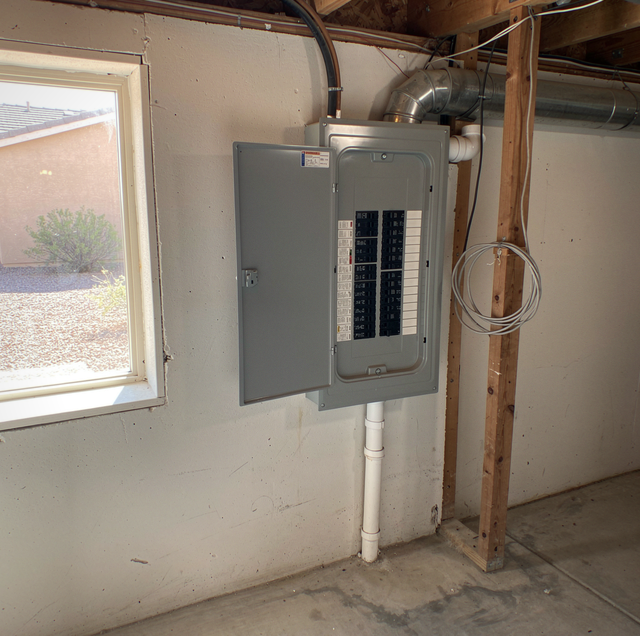
Most homeowners meet their electrical panel twice: once when a breaker trips, and once when someone else trips it. That second time it is usually a home inspector, an insurance agent, or an electrician, and two brand names change the conversation immediately: Federal Pacific and Zinsco.
Neither line is banned. Neither was recalled. A house with one is not on fire, and yours has probably run for decades without incident. The case for replacing them is quieter: a panel is a protective device, and a protective device you cannot count on has stopped doing the one thing you keep it for. The two brands got there by completely different routes.
Federal Pacific Stab-Lok: The Breaker That May Not Trip
A circuit breaker earns its place with a single action: when current exceeds what the wire behind the drywall can carry, it opens and the circuit goes dead.
Stab-Lok is the breaker design Federal Pacific Electric sold for roughly three decades starting in the 1950s, named for the way each breaker stabs onto the panel's power bus. The concern is failure to trip. In a real overload or short circuit, the mechanism may not release, and current continues to flow while the breaker holds.
What makes that hard to live with is the absence of any symptom. A Stab-Lok breaker that will not trip looks exactly like one that will, and it moves to off by hand and back on as willingly as any other, because the handle and the trip mechanism are separate parts inside one housing. Moving a handle by hand proves the handle moves. It does not prove the breaker will open on its own against fault current.
Testing whether one of these breakers still trips is not a homeowner job and cannot be judged by feel. The cover behind the panel door hides bus metal that stays energized with every breaker switched off.
Independent testing since then on breakers pulled from service has reported failure-to-trip rates for this line well above those of other brands under the same bench procedure. How far that carries into a lived-in house gets argued about. Thirty quiet years say nothing about the one moment that matters, the way a spare tire says nothing until the day you need it.
The Investigation That Closed Without a Verdict
In June 1980, the company that then owned Federal Pacific Electric told federal safety regulators that many FPE breakers did not fully comply with the testing lab requirements to which they had been listed. Regulators opened an investigation, and their own testing confirmed the breakers failed certain calibration tests. Those tests check whether a breaker holds its rated current and then opens within specified time limits when an overload increases the current. Its work centered on two-pole breakers built before the parent company acquired FPE in 1979.
The investigation closed in March 1983 without a recall. Regulators said the available data did not establish that the breakers posed a serious risk of injury, and its staff said plainly it had insufficient data either to accept or refute the manufacturer's position that the calibration failures created no household hazard. Settling it would have required more testing than the agency was prepared to fund within a limited budget and given other known hazards, so it stopped, noting that it could reopen the file later.
A closed investigation is not a finding of safety. What closed was the file, not the question. The agency has since attached a note to its own announcement advising readers to interpret it carefully: the matter ended without any determination about the safety of the breakers. The panels carried a listing when they were sold, which is why they went into so many houses and why no one was ordered to remove one.
Zinsco and Sylvania-Zinsco: Damage at the Bus Bar
Behind the breakers in any panel runs the bus, a flat metal spine carrying incoming power across the enclosure. Every breaker clips onto it at one small contact patch, and in a Zinsco panel that patch is where the trouble lives.
Zinsco panels used an aluminum bus. Aluminum expands and contracts more than copper as it heats under load and cools again, and it forms a surface oxide that conducts poorly at the interface between bare metal and air. Pair that with a breaker that grips the bus rather than bolting to it, and the joint loosens and gains resistance. Resistance under load makes heat; heat degrades the contact, and the worse contact makes more heat.
Carried far enough, the breaker fuses to the bus it was meant to clip onto. The handle still moves after that. You can push it to off, and the breaker will look off, while current crosses the welded joint and feeds the circuit anyway. It can no longer trip either, because the fused metal has bypassed the contacts the mechanism was built to separate.
What changes the conversation is which part took the damage. A burned stab position is damage to the panel's own bus, and bus assemblies for these panels cannot be ordered, so the finished component is the panel rather than a breaker inside it. One note for identification: Zinsco's designs changed hands in the 1970s, so the same interior appears under the Sylvania and GTE-Sylvania names.
The Replacement-Breaker Problem Both Panels Share
Suppose a breaker in one of these panels finally quits and simply needs replacing. That ordinary repair is where both brands get quietly worse, and it is why electricians raise the topic in houses with no complaints.
Neither line has been manufactured for decades, so what is available falls into two piles: salvaged breakers pulled from other old panels, carrying the same age and mechanism as the one being replaced, and aftermarket breakers built to the old physical shape, where whether that particular breaker is properly listed for that particular enclosure is not always answerable. A breaker is only protection if it is listed for the panel it goes into.
So even routine work chips away at the panel. Every added circuit or replaced breaker means putting a part into the enclosure that is either old stock or an unverified match.
Identifying Your Panel Without Opening It
Start at the panel door and stay there. Everything you need to name the brand is printed on the outside or is visible the moment the door swings open.
The label on the door: Most panels carry a printed label listing the manufacturer and the panel's ratings, usually on the inside face of the hinged door or on the outside of the enclosure. Federal Pacific labels read Federal Pacific Electric, Federal Pacific, or FPE. Zinsco labels read Zinsco, Sylvania, or GTE-Sylvania.
The name on the cover: Where the label is gone or unreadable, the brand is often stamped on the metal cover or across the face of the door itself.
The look of the breaker handles: Open the hinged door and read the row of handles. Federal Pacific breakers are marked "Stab-Lok" and usually have a red or orange stripe across the handle. Zinsco handles are the opposite of subtle: red, blue, green and brown instead of a uniform black, often in a single vertical column rather than staggered double rows.
Photograph the door label and the full row of breaker handles before you call anybody. Those two pictures let an electrician confirm the brand from the office and give an insurer something specific to work from.
Opening the hinged door to read handles is safe. Removing the metal cover behind it is a different act, and not a homeowner task under any circumstances.
Inside the Job: Permit, Utility, and a Day Without Power
Replacing a panel reaches further into a house than the box on the wall suggests, and the paperwork is part of the work. A permit gets pulled with the local building authority before anything comes off the wall, and an inspector who does not work for the electrician signs off on the finished installation.
The utility takes part too. The conductors feeding the panel are live all the way back to the meter, and nothing inside the house de-energizes them. Service is disconnected by the utility and reconnected once the installation passes, and that scheduling, more than the wiring, sets the shape of the day.
Current requirements then apply to what is being installed, extending beyond the panel to the service-entrance conductors, the meter enclosure, and the grounding electrode system. On a house of this vintage, some or all of that hardware is still original, so bringing it current belongs to the same job. Circuits move onto the new bus one at a time, with arc-fault or ground-fault protection added where current rules call for it.
Plan on hours without power, and think ahead about refrigerators, freezers, well pumps, and anything medical.
Inspectors, Insurers, and a Sale in Progress
Home inspectors write these two brand names down on sight, and that one line in a report has a way of taking over a transaction. What the inspector records is usually a recommendation that a licensed electrician evaluate the panel, which flags a component with a known service history rather than declaring the house unsafe.
From there, the pattern repeats. The buyer's side asks for replacement or a credit toward one, the seller's side asks whether any of it is required, which it is not, and both end up negotiating over a panel no rule obliges anyone to touch, on a timeline set by a closing date.
Insurance runs a parallel track. Some carriers ask about panel brand on a new application, some raise it at renewal, and some decline to write a policy on a house with one until it has been changed out. Handling the panel before listing takes the issue off the table as a bargaining chip.
Frequently Asked Questions
The electrical code governs new work and does not generally reach back to require that existing listed equipment be torn out. Federal safety regulators also retained the ability to reopen the closed Federal Pacific file if new information warranted it, but have not done so.
Not in a way most electricians will stand behind. A swap leaves the original enclosure, bus, and main in place, carrying the same decades of heat cycling. Many panels of this era also used a split-bus layout, meaning there is no single main breaker that kills the whole panel, only several two-pole breakers each feeding part of it. That alone complicates shutting the panel down.
Not always, because the contact face where a breaker meets the bus sits hidden behind the breaker body. Scorching sometimes shows once the cover is off, and sometimes nothing is visible until a breaker is pulled. A thermal camera reading taken while the panel carries normal household load is one added check, since a degrading connection runs hotter than its neighbors.
No, and the variation is wide. Some carriers ask the panel-brand question only on a new application, some surface it at renewal or after a property inspection, and some never ask. Requirements differ by carrier and by state. Where a carrier requires the panel to be changed, the document it wants afterward is the signed final inspection record from the permit.
Not always in one stretch. If the meter or service point moves as part of the work, or the inspection cannot happen the same day, the job splits into two visits with power restored in between rather than one continuous outage. Ask which shape the job takes at scheduling, because a two-visit sequence and a one-day swap need very different arrangements.
A few draw similar attention. Certain other older panel lines from the 1980s come up in inspection reports for related reasons, and split-bus panels of any brand get noted for the missing single main disconnect. The Stab-Lok design was also sold in Canada under a different corporate name, so the same breakers turn up there under an unfamiliar label.
Have your panel identified by a licensed electrician — know exactly what is protecting your circuits before you need it to work. Zimmerman Electric Company serves Surprise, Sun City, Peoria. Call (602) 497-3365.
