
Does Pool Equipment Need Its Own Circuit? The Real Reason
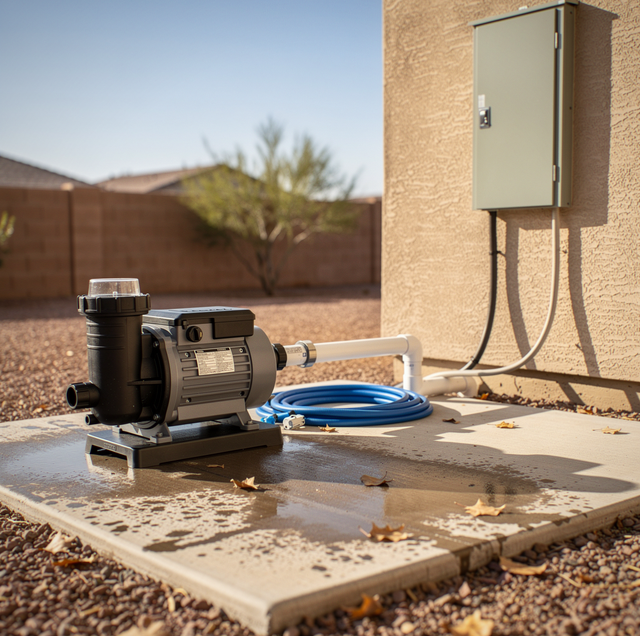
At the equipment pad, one breaker feeds one pump, and no other load shares it, even when the panel has room to spare. Your pool equipment gets its own circuit because of what it draws and how long it draws it. A pump pulls at or near its full running current for hours at a stretch, hits the circuit with a heavy surge every time the motor starts, and sits outdoors in a wet location its protection has to account for. Give that combination a circuit of its own and nothing else on the property has to share the surge, the hours, or the outdoor conditions.
A second question sits right behind that one, and it has its own answer: why the circuit feeding your pool gets protected differently from every other outdoor circuit on the house. That one is about what water does to a fault. Anywhere else outdoors, a loose wire or a cracked motor housing can make a metal fixture live, and you have to touch it to get hurt. At a pool, you are often already standing in or partly submerged in water that conducts, with wet skin that significantly lowers your body's resistance to the current. A stray voltage that would be a nuisance on a dry patio finds a new route through a swimmer's chest once water and wet skin lower the resistance in its way. What drives the separation is where a fault's current can go, keeping the people in your pool from ever becoming the shortest path between two points sitting at different voltage. Ground-fault protection and bonding answer that second question, and neither has anything to do with how many circuits feed the pad.
The Pump Motor's Own Demands
A single-speed pool pump runs long enough each day to turn over the pool's full volume of water, which, for most pools, means hours rather than minutes. That makes it a continuous load in the electrical sense: current flows at or near its full running value for the whole run. A circuit carrying a continuous load gets sized with that duration built in, beyond the peak number stamped on the motor's nameplate.
The motor also does something a steady load never does: it draws a heavy starting surge for a fraction of a second every time it kicks on. An induction motor's rotor is stationary at the instant of start-up, so the motor briefly looks like a near short circuit to the panel before it spins up to speed and its running current settles.
A single-speed pump's locked-rotor current, the figure printed on its nameplate, commonly runs five to eight times its full-load amperage for well under a second. That surge is what a shared circuit must absorb, on top of whatever else it feeds.
Put a second load on that same circuit and the two draws stack at the exact moment the motor starts. Breakers carry an inverse-time characteristic built to ride through a normal motor start, so a shared circuit often takes a pump without complaint, and that stacking can produce nuisance trips when the shared load is substantial. A dedicated circuit sidesteps the arithmetic entirely: your breaker only ever has to answer for one motor's habits.
Variable-Speed Pumps Change the Load Profile
A variable-speed pump ramps its draw across a range, from a couple of amps at a low circulation speed for filtering up to a much higher speed when you are vacuuming or running a spa jet mode, with a control board and a soft-start routine managing that transition smoothly. The soft start eases the surge problem a single-speed motor has, and introduces a different one: the electronics inside the drive are sensitive to voltage noise from anything else sharing their supply, and a shared circuit can feed that noise straight into the control board.
A variable-speed pump also tends to run longer over a day, because slow, steady circulation across many hours is where its efficiency gains come from. Its own circuit still matters here for a different reason than a single-speed motor's surge: it keeps the electronics inside your pump away from voltage noise a neighboring load might introduce onto the same supply.
What GFCI Protection Is Watching For
A ground-fault circuit interrupter continuously compares the current going to your pump on the hot conductor with the current returning on the neutral conductor. In a healthy circuit, those two match many times a second. If even a small amount goes missing, meaning current left on a path other than the one it arrived by, the device assumes that missing current found an unintended route, and it cuts power before that current can build.
That job differs from the branch breaker's job. The breaker protects the wiring and the pump from overload and short circuit, tripping only at many amps, far more than a leak into a swimmer's body would ever draw. A GFCI trips on a leak of a few thousandths of an amp, watching for current going somewhere other than where it arrived, which is exactly the leak a stray voltage near water can produce. Pool equipment gets that protection wherever it sits in and around water, because water lowers the resistance a stray current needs to overcome to reach you.
Equipotential Bonding Holds Everything at the Same Potential
Bonding explains why a pool is treated differently from any other outdoor circuit, and it is the part of the system that has nothing to do with how much power your equipment draws or how many circuits feed the pad.
Bonding's job is not to carry fault current away; it is to hold everything a swimmer can touch at the same potential, so there is no voltage difference across a body. The pool shell's rebar, the reinforcing wire mesh under the surrounding deck, the pump housing, the heater casing, and the water itself through a bonding fitting all tie into one continuous grid with a heavy copper conductor.
The reason this matters has little to do with keeping current out of the water in the first place. Stray voltage from a degraded motor winding, a nicked underground cable, or an ordinary utility grid imbalance can impose a small, otherwise harmless voltage on a bonded metal surface or the deck's reinforcing steel. On dry ground, that voltage does little. In a pool, a swimmer's hand on one bonded surface and feet on another, or two swimmers touching different points on the grid, form the path along which the voltage difference tries to equalize. A bonding grid removes the difference before a body ever has to close it. Every point on the grid rises or falls together, so there is nothing left for a person to feel.
A bonding fault does not trip a breaker and does not announce itself. A pool can run normally for years while a bonding connection quietly fails, leaving two touchable surfaces at different potentials. Bonding gets verified by an electrician, never by touch.
Bonding and Grounding Do Different Jobs
Bonding and grounding get used interchangeably in ordinary conversation, and around a pool that mix-up matters because the two systems solve different problems.
Grounding provides a deliberate path for fault current back to the source, allowing a breaker to detect it and open the circuit, cutting power to the faulted equipment. It clears a fault. Bonding gives a swimmer's body nothing to feel in the meantime, whether or not any fault current is flowing, by holding every touchable surface at a single potential. A pool's equipment ground and its bonding grid are usually separate conductor networks that connect at points, but serve different purposes: one clears the fault; the other neutralizes what the fault would otherwise do to a person standing between two surfaces before that clearing happens. A pool can have a working ground and still present a shock hazard if its bonding is faulty, and even with excellent bonding, a working ground is still needed actually to clear a fault at the panel. Each one covers what the other cannot.
The Equipment Pad Beyond the Pump
A pump is rarely the only thing on your pad. A gas or electric heater adds its own load, and an electric heat pump in particular can draw enough continuous current to earn a dedicated circuit sized the same careful way the pump's is. A saltwater chlorinator on your pad, which runs a low-voltage current through a cell to convert dissolved salt into chlorine, needs its own control circuit and bonding connection, since the cell housing is another metal object in the water's path. A booster pump for a pressure-side cleaner is a second motor with its own starting surge, and stacking it onto the main pump's circuit reproduces the same nuisance-trip problem a dedicated circuit exists to solve.
Pool and spa lighting usually runs on its own path entirely: most fixtures step a 120-volt supply down to a low-voltage output through a transformer mounted well back from the water, so the fixture itself never carries full household voltage into a wet niche. Planning your pad means treating each of these as its own load with its own protection, sized to what it actually draws.
An electrician sizing out your pad this way starts by confirming what already exists: how many circuits already run to it, what protects each one, and where the bonding grid connects, before adding anything new and giving each new load its own dedicated circuit. Whether a given load must be on its own circuit, and what protection it needs, are questions your local electrical authority answers through the permitting process, and the electrician who pulls that permit confirms the current requirement for your address before anything gets wired. If you are buying a home with an existing pool, the same walkthrough applies in reverse. An electrician traces every pad circuit back to its breaker, tests GFCI protection on each one, and checks bonding continuity at the shell, the deck steel, and the equipment housings, since years of sun, pool chemistry, and ground movement are exactly what degrade a bonding connection over time.
Frequently Asked Questions
Salt water is far more conductive than fresh or ordinary chlorinated water, because the dissolved sodium and chloride ions carry current more readily. That raises the stakes on bonding integrity specifically, since a saltwater pool offers a stray current an easier path through the water itself if any bonded surface in your system loses its connection.
Many above-ground pump and filter combination units connect by cord and plug and rely on GFCI protection built into the receptacle or the cord itself, and the nameplate on your unit states the amperage it actually draws. An in-ground pump's higher draw and longer duty cycle are what usually push it onto a dedicated hardwired circuit.
Any metal fixture you or a swimmer can reach, including ladder rails, handrails, and a diving board's anchor sockets, gets tied into the bonding grid with its own bonding lug or clamp. An isolated metal fixture that a swimmer can grab becomes its own small island at a different potential from everything around it, which is exactly the gap the grid closes.
The reinforcing wire mesh or rebar inside a new deck pour has to be bonded into the grid again before the concrete goes down, because that steel is one of the surfaces the grid depends on. Pouring new deck concrete over unbonded reinforcing steel recreates the same voltage-gradient risk that the original bonding work was intended to eliminate, even though the deck looks identical on the surface.
An automatic pool cover's motor and a solar heater's circulation valve actuator are both loads sized and protected against their own nameplate draw and starting behavior, each getting its own dedicated circuit separate from your pump and from each other.
Corrosion at a bonding lug, the metal clamp where the grid's conductor attaches to rebar or to a piece of equipment, is a common way a working bonding grid degrades over years; the lug itself is usually bronze specifically because that resists corrosion better than the steel it clamps to. A continuity check at each connection point confirms the grid a prior owner installed is still doing its job before you take the pool on.
Schedule a pool equipment electrical evaluation — get every pad circuit and bonding connection confirmed by a licensed electrician before you add equipment. Zimmerman Electric Company serves Surprise, Sun City, and Peoria. Call (602) 497-3365.
