
AC Disconnect Box Buzzing or Hot: Why Nothing Trips
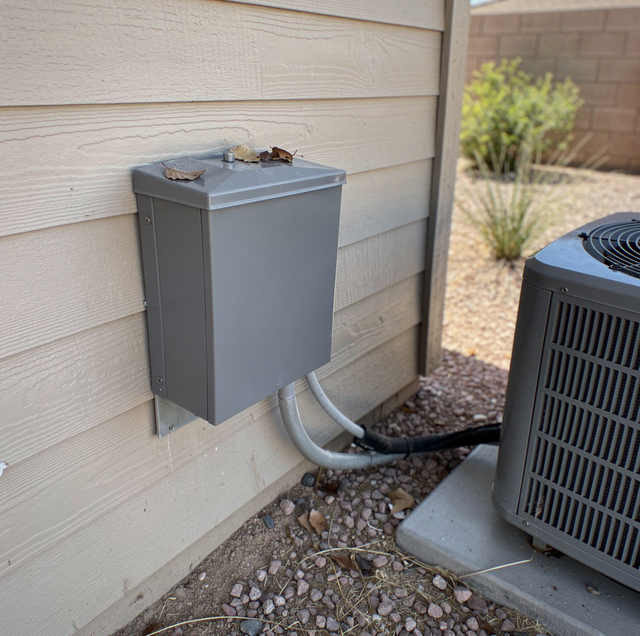
The box bolted to the wall beside your outdoor air conditioning unit is small, gray, and easy to walk past. Then one afternoon you notice it, either because you hear it humming while your unit runs, or because you pass close enough to feel warmth coming off a lid that used to match the temperature of the wall behind it.
Nothing has tripped. Your house is cool, your breaker sits where it always sits, and your air conditioner runs the way you remember it running last week. That combination is the part that confuses you, and it is the most useful thing you have, because a connection can hum and heat for a season before it does anything you would call a fault.
The Box on the Wall Beside the Condenser
That box is a service disconnect: it lets an electrician open the circuit to your outdoor unit, though the supply side stays live whatever the handle is doing. Inside, the conductors arriving from your panel terminate on a removable block or a switching mechanism, which sits between them and the conductors leaving for the equipment. All of it is electrical work. The sealed refrigerant system inside the unit belongs to an air conditioning contractor.
Two things make this the hardest-working set of connections on the outside of a house. It carries the largest single motor load most homes have, through the hottest hours of the day, on and off, for months at a stretch. Sun on the enclosure adds to what is already there. A hum or a warm lid points at neither the compressor nor the fan; it points at the connections inside the box.
The supply side of an AC disconnect remains live regardless of the handle position, so a buzzing or hot enclosure should be opened and evaluated by a licensed electrician, never by the person who noticed it from the walkway outside.
Where Heat Has Nowhere to Go, What Fails First?
The chain is plain: loose connections from improper torqueing lead to increased resistance over time at the termination, causing a temperature rise that can degrade the termination and any protective insulation around it. Resistance where a conductor meets a lug turns working current into heat, and that heat works on the two things nearest it, the termination metal and the insulation around it.
That also explains why none of this trips anything. When terminations are not properly torqued, a voltage drop can appear across the poor connection, and under reduced-voltage conditions, electrical equipment may not operate effectively, significantly reducing its lifecycle. A breaker interrupts overcurrent. A poor connection lowers the voltage reaching the equipment; it does not raise the current your breaker watches for, so your panel stays quiet while the box does not.
The Buzz, the Gap, and the Arc Between Them
Arcing follows the same pattern: it can occur from phase to phase, phase to neutral, or even phase to ground at improperly torqued terminations where bare conductive material is exposed. A gap at a termination is a place where current has to cross open air to keep going, and crossing air is not a quiet business.
That arcing condition, caused by gaps in the conductive components of the termination, can lead to a high-resistance connection, and the increased heat degrades the termination and ultimately the system's reliability. So the noise and the warmth are one event, heard and felt at the lid.
The pattern you hear is worth holding on to. A hum that arrives when the compressor starts and fades once it is running is a different observation from a rasp that carries on for the whole cycle. Some noise at an outdoor unit comes from switching gear in the equipment, a question for the air conditioning contractor.
Aluminum, Air, and the Oxide in Between
There is a second mechanism, and this one turns on the metal that a termination is actually made from: aluminum and copper can develop oxidation at the termination point where exposed to air, and oxidation at an improperly torqued connection can raise resistance at the termination and, with it, heat, reducing the reliability of the termination.
A feeder run out to an outdoor unit is aluminum in many houses; the terminations inside sit in outside air as installed, and the oxide described above forms exactly there. None of that is a defect in the wire. It is an ordinary condition meeting a connection that was never brought to its proper tightness.
Then there is the cycling. Metal grows as it warms and shrinks as it cools, and a termination on a circuit that runs hard through a long cooling season makes that swing daily. A connection made correctly has the clamping force to ride it out. A loose connection has that force applied to it every time your equipment starts.
Fused and Non-Fused Pull-Outs Are Different Products
Fused and non-fused pull-outs are built as separate catalog items, not two settings of one device. At 240 volts AC, single-phase two-wire, a fused pull-out carries two fuses, while a non-fused pull-out carries none. The distinction gets made at the point of purchase, long before anything is mounted on your wall.
That matters for the question you are asking, in two ways. If nobody finds fuses in your box, that is a fact about which device was bought and installed, not a sign that something has gone missing from it. And a fused pull-out puts a fuse holder into the circuit, which is another pair of contacts sitting under the same sun and taking the same daily heating, inside a box where contact quality is the whole story.
What the Trade Looks For, and What You Can Watch
The reflex, once heat and a loose connection turn up together, is to go and tighten something. That guidance closes the door on that reflex: re-torquing terminations after the initial, proper torque during installation is not recommended. Instead of a re-torque, electrical-maintenance guidance calls for infrared scans and visual inspections to detect loose connections. Both are worth understanding, because between them they are the visit you are booking. An infrared scan is taken while the circuit is carrying load, so the connection is doing the very thing that heats it at the moment it is looked at, and a visual inspection is a search for discolored metal and cooked insulation. It is a scheduled call with an instrument in hand rather than a screwdriver moment.
None of that leaves you with nothing to do. Observation from a step back is unusually useful, and it is yours to give. Note when the noise began, whether it arrives with the compressor or runs steadily, and whether it happens on every cycle or only some. Note whether your cooling has fallen off or the equipment has started cycling short. Note any discoloration on the outside of the enclosure.
The boundary is worth stating plainly, because two trades meet at this box. The enclosure, the conductors landing in it, the terminations, and the whip running out to the equipment are all electrical, and they are your electrician's to evaluate. The compressor, the refrigerant circuit, and the sealed system behind it are the air conditioning contractor's, and a buzzing disconnect is no reason at all to call one.
Details worth having ready for the booking call: when the noise started, whether it tracks the compressor coming on, whether cooling has changed, and what else on that circuit was worked on.
Caught while it is still a noise, the work is a service call, a look under load, and a connection remade, or a device swapped out. Left until the heat has taken the terminations, the conductor ends and the enclosure with them, the same complaint turns into a rebuild of the whole outdoor connection point, and your electrician arrives to a longer list.
Frequently Asked Questions
That guidance includes one exception: if necessary, a torque tool set to 90% of the recommended value may be used to detect a loose connection on a de-energized circuit. That is your electrician's procedure, not something you attempt yourself, and no reason for you to open anything.
Then you have a safety switch. Safety switches are built into general-duty and heavy-duty families, with features a pull-out does not have: a cover interlock, a visible blade with double-break switch action, a quick-make and quick-break mechanism, and padlocking provisions. Your heat question is unchanged, because your terminations are the same in your box.
That is the first thing worth separating, and it decides which trade you call and when you call them. A noise from the disconnect at the wall; a noise from inside the equipment cabinet at the unit. If your ear cannot split them apart, your electrician can, and the disconnect is the quicker of them to rule out.
That guidance is direct about it, and this is the part homeowners find hardest: in reduced voltage conditions, equipment may not operate effectively, and its lifecycle may be significantly reduced. So a connection nobody has looked at quietly taxes your compressor every hour it runs, shows up as no fault code and no tripped breaker, and gives your first warning as the buzz you noticed on your wall.
That short run is the whip, and it is electrical work, so it belongs with your electrician along with the box it leaves. It is flexible on purpose, because the equipment vibrates and the wall does not, and its terminations at both ends are the same kind of connection described above. Heat at either end of your whip lands you in the same conversation, and your air conditioning contractor will say so.
Because rain is the only weather your enclosure is built to shrug off. A Type 3R enclosure rating covers outdoor use primarily to provide a degree of protection against falling rain and sleet, and it must remain undamaged by ice formation on the enclosure -- it is not intended to provide protection against conditions such as dust, internal condensation, or internal icing. Dust and condensation sit outside what that rating promises you, so a dry year buys your terminations nothing, and your enclosure keeps doing the job it was sold to do while the connections degrade anyway.
Have the disconnect beside your outdoor unit evaluated by a licensed electrician — an infrared look under load and an inspection of the terminations will separate a connection that can be remade from a device that has to be replaced entirely, and neither call belongs to the homeowner. Zimmerman Electric Company serves Surprise, Sun City, and Peoria. Call (602) 497-3365.
