
What a Hot Attic Does to the Wiring Above Your Ceiling
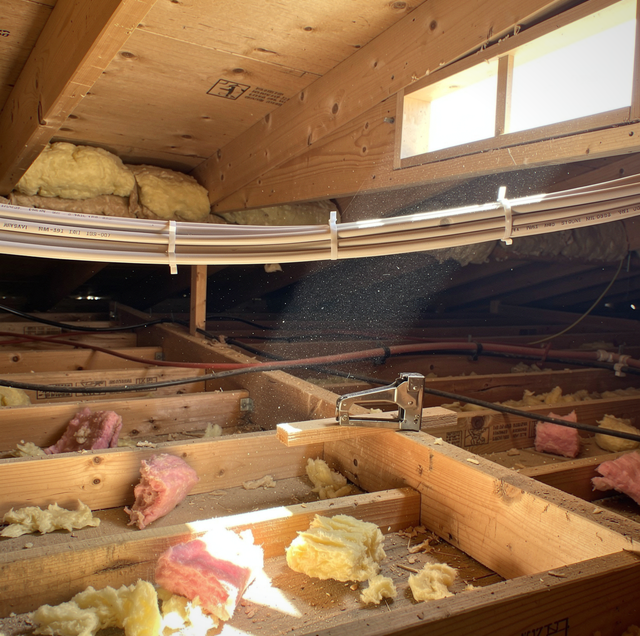
You have probably heard a version of this, maybe in your own head on a ladder with your hand on the hatch: wire is wire. If your cable was sized right when the house went up, and your breakers have never tripped, then whatever happens above your ceiling in August is weather, not wiring.
That idea is wrong in one narrow way, and the narrow way is worth your attention. The current your cable can safely carry is not a property of copper alone. It was always a property of the copper plus the air around it, and the air in your roof space on a bad afternoon is nothing like the air that number assumed when somebody sized your circuit for you.
Why a Circuit's Rating Was Never About the Copper Alone
Ask what size wire a circuit needs, and you get a number back, and it sounds like a fixed property of the wire itself. It is not. Ampacity refers to the maximum safe current a conductor can carry continuously under specific operating conditions, without exceeding its designated temperature limit. The quiet work sits in the middle. Under specific operating conditions.
Those conditions are not a formality. They are the ambient temperature of the air the cable sits in, how many current-carrying conductors are bundled in one run, and how hot the insulation around each conductor may get. The limit being protected is a temperature. Current is the only lever that holds that temperature where it belongs, which is why one piece of copper is rated for one number in a cool basement and a smaller one in an attic.
Change the air, and you have changed the circuit, even though nothing about the copper moved. Nobody rewired anything. Nobody added a load. The cable stapled across your joists is doing what it did in April, and the load it can safely carry has come down regardless.
The 60 Degree Column Hiding Inside a 90 Degree Cable
The flat white, yellow, or orange sheathed cable behind most of the drywall in a house built since the mid-1980s is NM-B. Its conductors are wrapped in insulation rated to 90 degrees Celsius, a rating required by safety-listing standards so they survive the heat inside a lighting fixture where they land. Strip a piece, and that rating is printed right there in the legend.
The two numbers part company right there. NM-B cable is limited to the ampacity figure given for 60-degree Celsius conductors, not the figure given for the 90-degree insulation wrapped around them. So, one cable has a 90-degree insulation rating and a 60-degree loading allowance, and the two are not in conflict. The insulation rating is a survival specification, describing the temperature the plastic can sit at without breaking down. The loading allowance is a system specification, and it accounts for the breaker lugs, the receptacle screws, the wire nuts, and the device terminals at both ends of the run, almost none of which are built to sit at 90 degrees. A circuit is only as generous as its least generous component, and in a residential branch circuit that component is almost never the conductor insulation. Which means the headroom you might assume the 90-degree rating buys you in a hot roof space was already spent before the cable came off the reel.
This matters most where people assume it does not. Everyone knows an overloaded circuit runs hot. Far fewer picture the reverse: a circuit carrying a load it was correctly sized for, on cable nobody installed wrong, in air so hot that the correct load is no longer correct.
What the Ampacity Tables Assume Before You Read Them
Every published ampacity table is printed against an assumed ambient temperature, and for the common tables that assumption is 86 degrees Fahrenheit. Above that, the printed value has to be corrected downward before it means much. Those ampacities do not reflect any temperature correction or ampacity adjustment that may be required.
The table is a starting point you correct; then: ambient temperatures in attics can easily run 30-50 degrees Fahrenheit higher than the outdoor temperature. For the types pulled in conduit, like THHN, THWN-2, and XHHW-2, the correction is applied to the higher rating, leaving more of the original figure still standing.
What Dims a Light Long Before a Breaker Trips?
Copper's resistance increases as the copper warms. The relationship has a name you can look up: the temperature coefficient of resistance for copper, and it is no trivial effect across the range between a conditioned hallway and a roof space in August. As resistance increases, more of the supply voltage is spent pushing current through the wire itself, and less reaches whatever you have plugged in at the far end.
The symptom that results is a sag, not a trip. You notice the kitchen light dip when the compressor kicks in, or a bathroom fan running a half-step lower on the hottest afternoons, or a garage circuit where a saw bogs down at three in the afternoon and pulls fine at seven. None of that moves a breaker, because a breaker watches current through its own thermal element and cannot know how hot the air around the run has become.
The frustrating part for you is that the same symptom has half a dozen ordinary causes, most of them nothing to do with heat: a loose neutral, a failing device, a dimmer mismatched to its load. Temperature is the one cause that comes and goes with the season, which also makes it the easiest to talk yourself out of.
Cable Types Compared: What Changes When the Air Gets Hot
Not every conductor in a house reacts to a hot roof space the same way, and the difference is not the copper. It is the column from which each type's allowed ampacity is taken before any correction is applied.
| Conductor type | Insulation rating | Where its ampacity comes from | What hot air changes |
|---|---|---|---|
| NM-B sheathed cable, flat, in most walls | 90 degrees Celsius | The 60 degree Celsius column | Starts lowest, so the usable figure falls furthest |
| THHN and THWN-2, pulled in conduit | 90 degrees Celsius | The 90-degree Celsius rating, where terminations allow | Starts higher, so more of it survives |
| XHHW-2, cross-linked insulation | 90 degrees Celsius | The 90-degree Celsius rating, where terminations allow | Same, on insulation rated wet and dry |
Read across that last column and the practical shape comes out: the type most likely to be crossing your attic is also the type with the least headroom to give away. None of that argues for pulling cable out of a ceiling that has been fine for decades. It argues for knowing which conductor is up there before anybody adds a load to it.
Load Heat and Ambient Heat Are Not the Same Problem
Undersized wire heats from the inside. Current passes through it, the conductor's own resistance turns part of that current into heat, and the cable warms along its length because of what it carries. That is a load problem with load answers: a larger conductor, a smaller load, or a circuit split in two.
Ambient heat works the other direction. The cable is the right size, the load is the right size, the installation is clean, and the air around the run is simply hotter than the table assumed. The conductor starts from a higher baseline before it carries a single amp, so an unchanged load pushes its insulation nearer its limit than it did in a cooler room. Nothing about the circuit changed. Its surroundings did.
Both roads end in the same place: insulation above the temperature it was built for, and the failure that follows looks identical from outside. Diagnosis is where they separate. A load problem can show up at the panel and at the device on any day of the year. An ambient problem stays invisible eight months and behaves badly for four, which is why it gets written off as coincidence for years instead of being looked at once.
What Twenty Summers Do to a Run You Cannot See
Thermoplastic insulation does not fail on the first hot afternoon. It ages, and it ages faster in warm weather than in cool. Twenty summers of heating and cooling cycles work on a run in small ways that add up: the plastic stiffens and loses flexibility, the cable expands and contracts against every staple holding it to a joist, and the connections at each end cycle a few thousand times.
Connections are usually where it turns up first. A terminal screw that was properly tight in a cool room can relax across enough thermal cycles, and a slightly loose connection makes heat of its own, which loosens it further. Splices inside a junction box in a hot roof space live in the worst version of that loop, somewhere nobody has looked since the drywall went up.
Do not climb into a hot roof space to trace, tug, or re-staple cable yourself; send an electrician. Heat in a closed attic can overwhelm a person before it hurts the wiring, and you cannot safely test a live conductor up there.
What an electrician actually goes up to look at is narrower than most homeowners expect: the conductor type and gauge in that space, what your circuit feeds now versus what it fed originally, whether anything has been added since, and whether any splice is outside a box someone can reach.
Frequently Asked Questions
Not on its own, no. A correctly installed cable in a hot roof space is not hazardous just from the air temperature. Heat shrinks the margin between what your circuit carries and what it may safely carry. So the question you face is never heat alone. It is heat plus whatever you added to that circuit since you bought your house.
A breaker protects the conductor from excessive current and does so well. It has no sense of the air temperature around the middle of the run it feeds. Your cable can spend every July afternoon warmer than its rating assumed and never draw enough current to move the breaker, because the two measure different things. That gap is why ambient heat goes unnoticed for years in your house, and why you want an attic circuit addition on your list to ask about before you make it rather than after.
Much less, and for a simple reason: the air inside a conditioned wall cavity stays much closer to the temperature assumed by the rating table. The same cable running through your living room wall and your roof space is a single conductor with two very different environments along it, and the hottest stretch is the one that limits what your whole run can carry, even if the rest of your house stays cool.
It helps the house, and it can complicate the cable. More insulation on your attic floor keeps your rooms cooler and usually makes the attic air above that insulation hotter, not cooler. Cable that ends up buried under new loose fill also loses the airflow that carries heat away from it. Neither is a reason for you to skip insulating, but both are worth flagging to your electrician before your crew arrives.
Sometimes, rarely from a glance. Discolored insulation, a stiffened jacket, and heat marks at a terminal point back at a run that spent time above its comfortable range. Live measurement under load on your hottest afternoon is worth more to you than any of that, which is why you want your attic looked at in your own summer heat rather than a mild morning.
Ask which conductor type is up there, what the correction for the real attic temperature does to its allowed capacity, and whether your new load belongs on that path at all. Those three questions cover most of what goes wrong in an attic, and your electrician can answer all three in one visit without anyone having to guess at the rest.
A phone photo of the cable running overhead will show you the type stamp and the gauge, and that much is useful as far as it goes. What it cannot show on its own is how hot that run truly gets, what has already been spliced into it since, or what your circuit is being asked to carry now.
Planning a new circuit through a hot roof space, or wondering what the cable already up there can safely carry — get the conductor type, the run, and the real load looked at by an electrician before you put anything new on that circuit. Zimmerman Electric Company serves Surprise, Sun City, and Peoria. Call (602) 497-3365.
