
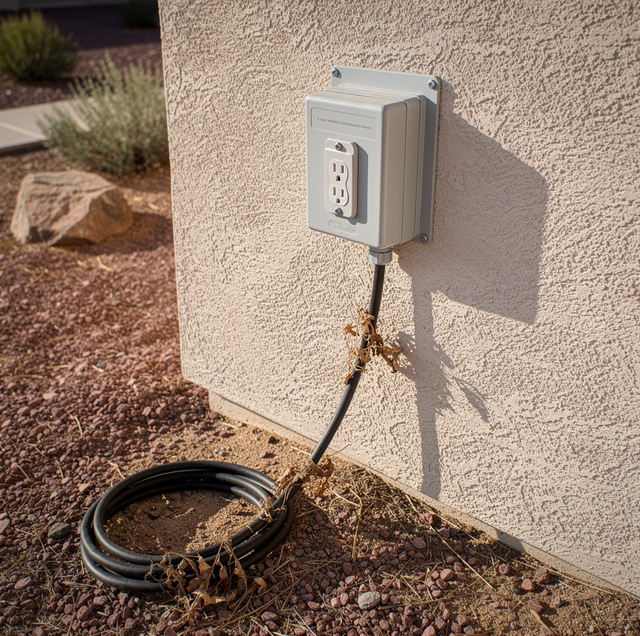
A low-voltage outdoor lighting system has two halves. A transformer, plugged into an outdoor receptacle or wired into a household circuit, steps down household power. From its terminals, a two-conductor cable runs out through the beds and the lawn at a shallow depth, and each path light, spotlight, or well light is tapped onto that cable along the way. Everything past the transformer lives in the soil, where people dig. An edger cutting a new bed line, an aerator punching the lawn, a trench for a new irrigation line or a shovel making room for a shrub can nick the jacket or sever the copper, and nothing marks the moment it happens. The lights fail to come on that evening or some evenings later, after the soil is raked smooth.
Some outdoor lighting is line-voltage instead, fed from a household circuit with no transformer anywhere in the system, and a cut in that cable poses a shock hazard. On either kind, a damaged cable is never handled while the system is powered. A low-voltage transformer is shut off at its source before an electrician touches the cable ends; a line-voltage run has its circuit shut off by an electrician; and nobody opens the transformer or works on the household-power side.
Each pattern of dark and lit fixtures corresponds to a stretch of the system where the fault can occur.
| What the fixtures show | Where the fault can sit |
|---|---|
| Every light on the run is out | At the power supply, or at the cable where it leaves the transformer ahead of the first fixture |
| Lights out past one point, lit before it | At a cut in the cable between the last lit fixture and the first dark one |
| Lights flicker or come and go when the ground is wet | At a damaged splice or a nicked jacket that lets water reach the copper |
| One fixture out while its neighbors work | At that fixture, its lamp, or the short lead joining it to the main cable |
| Lights out and the transformer also dark | Upstream of the run: the receptacle, the household circuit, or the timer or photocell |
Ruling Out the Power Supply First
A dark yard right after digging suggests a cut cable; it could be that, but the supply feeding the transformer can also fail with the cable untouched.
The receptacle: A transformer plugged into a receptacle with no power goes dark with it, and a lamp or radio plugged into the same receptacle shows whether it is live; a ground-fault receptacle that trips is its own question, with its own list of causes.
The timer: A timer knocked off its schedule by an outage can hold the lights off at night with the cable intact, and its dial or display shows whether the on and off settings still match the clock.
The photocell: A photocell switches the system on when it senses darkness and holds it off when it senses light, so a new porch light or floodlight shining on it can keep the run dark even when nothing is wrong in the yard.
When the receptacle is live, and the timer and photocell are calling for light, the fault can be in the transformer itself or at the cable connection at its terminals, and diagnosing the transformer is work for an electrician. A dark run with a working supply does not prove that the damage is near the house, though. A blade that pinches both conductors together can short them, and a transformer with overload protection shuts down its output when that happens, darkening every fixture even though the damage occurs partway along the cable.
Reading Which Fixtures Went Dark
Current leaves the transformer on one conductor and returns on the other, and each fixture draws from the pair where it taps in. A break in either conductor stops current from reaching everything beyond that point, so a cable with one wire cut and one intact behaves the same as a cable cut clean through. Fixtures between the transformer and the break stay lit, and fixtures past it go dark, which places the break somewhere between the last lit fixture and the first dark one.
The layout decides which fixtures count as past the break. On a run where the fixtures are tapped one after another along a single cable, every fixture beyond the cut goes out. On a run that splits at a T connection or a hub into branches, a cut on one branch darkens that branch while the others stay lit. Fixture order in the beds is a partial guide, because a cable can double back or feed a far fixture before a near one.
A written note of which fixtures stayed lit, which went dark, and which flicker, made at dusk before anything in the beds is moved, keeps the evidence intact, since a fixture knocked over later can change what the run shows.
A single dark fixture with lit neighbors on both sides means the main cable is carrying current past it, so the fault is local: the lamp, the socket, or the short lead joining that fixture to the cable, which a string trimmer or a driven stake can cut without touching the main line. A run that works on dry nights and flickers or drops out when the soil is wet can have water reaching copper through a nicked jacket or a splice, giving current a path it should not have.
Where the Ground Was Dug, and Other Ways Cable Fails
That dark stretch is then compared with where the recent work happened. When fresh edging, a new planting hole, a trench, or a line of aeration cores crosses that stretch, the disturbed soil is the first place checked, and the break sits at or near a spot where a tool went deep enough to reach the cable.
Yard work is one cause among several, and a failure that shows up after digging may have come from something else:
- A shovel or spade: A clean cut in one place, with both conductors severed or one left hanging by a few strands.
- A stake: An edging stake, a plant stake, a new fence post, or a staked tree driven through the cable can pierce the jacket and stay there, and water following the stake down can reach the copper.
- A gnawed jacket: Burrowing rodents can chew through the insulation and leave the conductors bare in the soil.
- Water in a splice: A connection that was never sealed for burial, or whose seal has failed, takes on water, and the copper inside corrodes until the joint stops carrying current.
When no disturbed soil lies on the dark stretch, an electrician can find the break with a cable locator, a tool that puts a signal onto the conductors and picks it up through the soil, marking the buried route and the spot where the signal ends.
Exposing the cable is digging, and it happens only after buried utility lines in the area are marked by the utility locating service, since a lighting cable can share ground with gas, power, and communication lines.
A cut on a line-voltage run can leave bare conductors carrying household current in open soil, where a blade or a wet hand can reach them. Exposing and joining those ends is work for an electrician with the circuit shut off.
How a Damaged Section Is Repaired or Rerouted
With the power off at the source, the electrician exposes the damaged section and removes the nicked or cut portion back to clean copper and sound jacket on both sides. Where the two ends still reach each other, the electrician rejoins them; where the cut removed a length of cable, a short piece of matching cable bridges the gap, with a connection at each end. Every connection is kept sealed against soil and water, since an unsealed joint in wet ground can start the flicker pattern.
Rejoining in place suits a cut from a one-time job, such as a trench now backfilled and planted over. When the cut sits under a bed that gets replanted each season, beside the edge of a new patio, or along a line where more digging is planned, a splice in the same spot can be cut again. That section is run on a new path: around the bed, along a wall or a hardscape edge, or through a sleeve under a walkway so it can be pulled later without breaking paving.
After the repair, the electrician powers up the system and checks every fixture before any soil is returned. A second nick further along the run can hide behind the first, because fixtures past two breaks stay dark until both are fixed. Any permit question for new outdoor wiring, such as a rerouted line-voltage run, is decided by the local authority.
Reburying and Mapping the Repaired Cable
A cable gets cut because it sits where a tool goes, so the reburial puts it somewhere tools do not. That means a depth past the reach of edgers, aerators, and ordinary planting holes, and a route that follows fixed features such as walls, walkways, and the edges of hardscape, crossing open beds as little as the layout allows. A cable left on the surface under mulch is within reach of a rake or a trimmer line, and a cable laid tight against a bed edge sits where the edger returns whenever that edge is recut.
The second half of the job is knowing where it went. A sketch of the route measured from fixed points, such as house corners, a wall, or the meter, turns the next dig into an informed decision. Photos of the open trench before backfilling, with a fixed feature in frame, record the same thing, and the map also shows where each splice sits. Flush markers at route turns keep the path visible between projects. The map does its work when it reaches whoever digs next.
Frequently Asked Questions
No. Tape adhesive loosens once it is buried and wet, and water creeps along the copper underneath it, while the twist-on connectors used indoors are open at the bottom and fill with moisture. A buried joint calls for a connector rated for direct burial, filled with a gel or grease sealant that surrounds the copper and keeps out soil water.
A blade that nicks the jacket without severing the copper leaves the circuit whole, so the lights stay on. Moisture then reaches the exposed metal, and the copper at the nick corrodes green or black, thinning strand by strand until too little metal remains to carry the current and the run goes dark.
A transformer can feed more than one cable from its terminals, and each of those home runs is its own circuit. A cut on one run darkens that run alone, while cables leaving the other terminals keep their fixtures lit, confirming the supply is working and narrowing the search to a single cable.
A single cut or short damaged length is spliced or bridged, and the rest of the run stays in service. Replacing the cable from the transformer outward is considered when the jacket has become brittle and cracks along its length, or when the run already carries several splices, since each joint is another place for water to enter.
No. The locating service marks lines owned by the utilities, and privately installed lines on the property, such as outdoor lighting cable, irrigation control wire, or a feed to a detached garage or shed, are left unmarked. Those are found from the installer's drawings or by a private locating company hired for the job.
A clean break leaves them without power, and a fixture sitting unpowered takes no harm from it, so lamps past the cut light again once the cable is rejoined. The exception is a fixture whose own lead or housing was struck by the same tool, which needs its own repair.
Engage outdoor lighting troubleshooting and repair for the dark run — a trace of the buried cable, a sealed repair at the break, and a new route where digging keeps reaching it. Zimmerman Electric Company serves Surprise, Sun City, and Peoria. Call (602) 497-3365.