
Why Your AC Keeps Tripping the Breaker in Summer
Quick Answer: An air conditioner trips the breaker when it draws more current than the circuit can safely carry. In desert summer heat, the most common causes are a dirty condenser or clogged filter making the unit work harder, low refrigerant straining the compressor, a failing capacitor or motor, a hard-starting compressor pulling a big surge, or an overloaded or weak breaker. Start with the easy checks — replace the filter, clear debris from the outdoor unit — then, because most AC-electrical faults involve refrigerant or high-voltage parts, call an HVAC or electrical pro if it keeps tripping.
It's 110 degrees out, the AC kicks on, runs for a while, and then the breaker snaps off, and the house starts warming up — again. An air conditioner that keeps tripping the breaker in the heat of summer is one of the most common (and most miserable) electrical complaints in the desert, precisely because that's when you need cooling most and when the system is working hardest. The breaker isn't being difficult; it's stopping a circuit that's pulling too much current. Finding out why is the key to getting the cool air back for good.
The Breaker Trips Because Something Is Pulling Too Much Current
A breaker has one job: cut the power when a circuit draws more current than it's rated to handle safely, before the wires overheat. An air conditioner is one of the largest electrical loads in your home, and anything that makes it work harder — or any fault in its electrical parts — pushes its current draw up. When that draw crosses the breaker's limit, the breaker trips. So a repeatedly tripping AC means the unit is either straining against something or has an electrical fault, and the summer heat makes it worse because the system is already running at maximum.
The Heat-and-Strain Causes
A Dirty Condenser or Clogged Filter
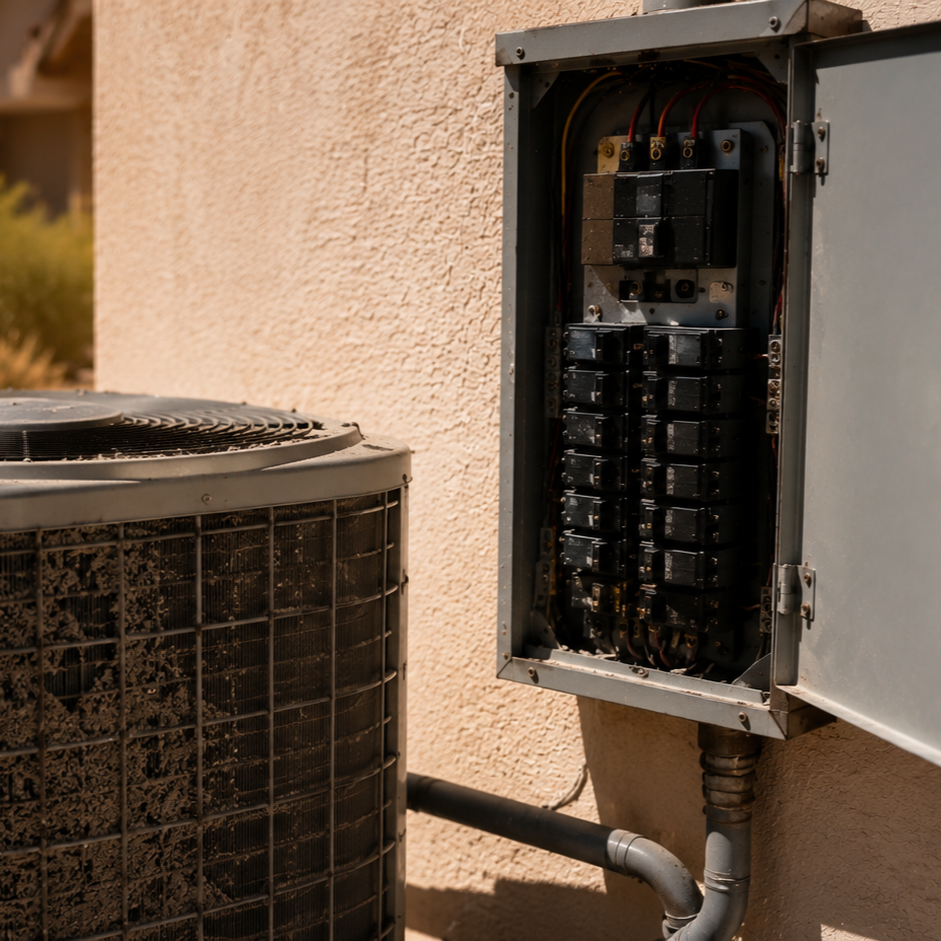
This is the most common and most preventable cause. Your AC sheds heat through the outdoor condenser coil, and it pulls air through an indoor filter. When the condenser is caked with dust, and the filter is clogged, the system can't move heat or air efficiently, so it runs longer and harder — drawing more current — to reach the temperature you set. In dusty desert conditions, both clog fast. A filthy unit straining in the heat can pull enough extra current to trip the breaker.
Low Refrigerant
If the system is low on refrigerant (usually from a leak), the compressor has to work harder and run longer to try to cool the home, raising its current draw. Low refrigerant also makes the compressor prone to overheating, which can trip the breaker as a protective response. This needs a professional, since refrigerant is a sealed-system issue.
The Electrical-Fault Causes
A Failing Capacitor
The capacitor gives the AC's motors the jolt of energy they need to start and keep running. As capacitors weaken or fail — and desert heat shortens their life — the motors struggle to start, drawing excessive current in the attempt. A failing capacitor is one of the most frequent AC electrical faults and a common reason for heat-season breaker trips.
A Hard-Starting or Failing Compressor
The compressor is the AC's largest motor, and it draws a large current surge every time it starts. If the compressor is wearing out or "hard starting" — struggling to get going — that startup surge can spike high enough to trip the breaker, often right as the unit kicks on. A failing compressor motor can also short internally, which trips the breaker immediately.
An Overloaded Circuit, Weak Breaker, or Loose Connection
Sometimes the AC is fine, and the electrical side is the problem. A breaker itself can weaken with age and heat, tripping at lower loads than it should. A loose or corroded connection at the breaker or disconnect generates heat and resistance that can cause tripping. And if the AC shares a circuit, it shouldn't; the combined load trips the breaker. Older homes with electrical systems not sized for modern cooling demands are especially prone to this.
| What you notice | Likely cause | What to do |
|---|---|---|
| Trips after running a while, unit dirty | Dirty condenser/clogged filter | Clean filter and clear the unit |
| Weak cooling, trips, possible ice | Low refrigerant | Call an HVAC pro |
| Trips at or near startup | Failing capacitor or hard-start compressor | Professional diagnosis |
| Trips instantly every time | Shorted compressor or wiring fault | Stop using; call a pro |
| Trips at low load, breaker old | Weak breaker or loose connection | Electrician |
Don't repeatedly reset a breaker that trips the instant the AC starts, and never replace it with a higher-amp breaker to stop the tripping. An immediate trip can mean a shorted compressor or wiring fault, and an oversized breaker lets the wiring overheat — a fire risk. Repeated instant tripping needs a professional.
What You Can Check and When to Call
The safe, homeowner-friendly steps are worth doing first because they solve a real share of cases: replace or clean the air filter, and gently clear leaves, dust, and debris from around and off the outdoor condenser unit so it can breathe. Make sure nothing is blocking airflow. These reduce the strain that causes heat-related trips.
Beyond that, AC breaker trips usually involve refrigerant, high-voltage capacitors, compressor motors, or panel wiring — all of which carry shock, refrigerant, and fire hazards and need proper tools and training. If a clean filter and clear condenser don't stop the tripping, or if the breaker trips instantly, the system needs an HVAC or electrical professional. In a desert summer, a dead AC isn't just uncomfortable — it can be a health concern in extreme heat, so it's worth resolving quickly.
Frequently Asked Questions
On the hottest days, your AC runs the longest and hardest to keep up, which pushes its current draw to the maximum. If the unit is dirty, low on refrigerant, or has a failing capacitor or compressor, the peak demand occurs when the draw finally crosses the breaker's limit. The heat itself also stresses electrical components and can weaken an aging breaker, so extreme-heat days expose problems that stay hidden in milder weather.
Yes. A clogged filter and a dust-caked condenser force the system to run longer and work harder to move heat and air, which raises its electrical draw. In dusty desert conditions, these clog quickly. A dirty, straining unit can pull enough extra current to trip the breaker, which is why cleaning or replacing the filter and clearing the outdoor unit is the first thing to check.
The tripping itself is protective, but the causes can be hazardous and shouldn't be ignored. An AC that trips the breaker instantly may have a shorted compressor or wiring fault, and repeatedly resetting it — or oversizing the breaker — risks overheating the wiring and starting a fire. Persistent tripping means a real fault that needs diagnosis, so it's safer to call a professional than to keep forcing the breaker back on.
The capacitor stores and delivers the burst of energy the AC's motors need to start and run. When it weakens or fails — and desert heat shortens its lifespan — the motors struggle to start and draw excessive current, which can trip the breaker. A failing capacitor is one of the most common AC electrical faults, and it's a part that an HVAC technician can test and replace.
It depends on the cause, and there's overlap. Refrigerant, capacitor, and compressor issues are in the HVAC territory, while breaker, wiring, and circuit-capacity problems are in the electrical. If cleaning the unit doesn't fix it, an HVAC technician can diagnose the AC side; if the issue turns out to be a weak breaker, loose connection, or undersized circuit, an electrician handles that. Describing exactly when it trips helps either pro zero in.
Stop the Strain or Find the Fault
An AC that keeps tripping the breaker in summer is drawing more current than its circuit can safely handle — usually because it's straining against a dirty unit or low refrigerant, or because a capacitor, compressor, or breaker is failing. Start with the safe basics: a fresh filter and a clean, clear condenser. If that doesn't end the tripping, the cause is in the refrigerant or high-voltage side and needs a professional. Don't just keep resetting it or size up the breaker — in desert heat, getting the system properly fixed keeps both your home cool and your wiring safe.
AC tripping the breaker in the heat? — Get the electrical side diagnosed and fixed safely by licensed West Valley electricians. Zimmerman Electric Company serves Surprise, Sun City, Peoria. Call (602) 497-3365.
