
Do You Need a Panel Upgrade for an EV Charger?
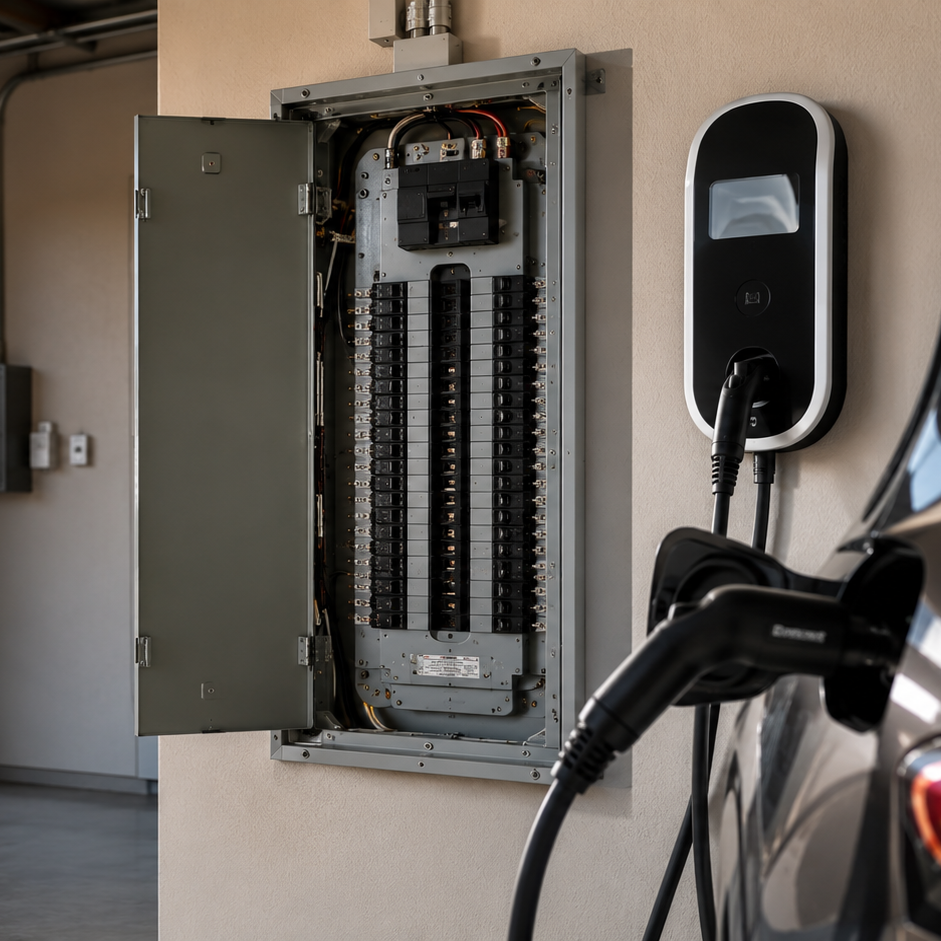
Quick Answer: It depends on how much spare capacity your panel has after everything else you run — and in a desert home, that "everything else" includes heavy air conditioning and often a pool, which eat into the available headroom. A Level 2 charger typically needs a 240-volt, 40-to-60-amp circuit. A modern 200-amp panel with room to spare can often add one without an upgrade; an older, smaller, or already-loaded panel frequently can't. An electrician determines it with a load calculation that accounts for your AC, pool, and other demands before adding the charger.
You've got the electric vehicle, and you want to charge it at home overnight instead of hunting for public stations. The question is whether your home's electrical panel can handle a charger as-is or whether it needs upgrading first. In the desert, that question has an extra wrinkle most online answers skip: your air conditioning and pool are already drawing heavily on the panel, so the headroom left for a charger is often tighter than you'd expect. Here's how to think it through.
An EV Charger Is a Big Load on Top of Big Loads
A Level 2 home charger — the fast kind most EV owners want — runs on a dedicated 240-volt circuit drawing roughly 40 to 60 amps, comparable to adding a major appliance that runs for hours. The core question isn't whether your panel can physically connect a charger; it's whether it has enough unused capacity to supply that much additional power on top of everything your home already runs, without exceeding its safe rating.
In a desert home, "everything already running" is a lot. Central air conditioning works hard for months and is one of your largest loads, and a pool pump adds more. Those demands already claim a big share of the panel's capacity, which means the headroom left for a charger can be slim — especially on hot days when the AC is running full tilt and you'd also be charging. That's why the desert answer to "do I need an upgrade?" leans toward "have it calculated" more often than in milder climates.
The Two Things That Decide It
The decision comes down to two separate questions, and both have to check out.
First, total capacity: your panel has a maximum rating — often 100 amps in older homes, 200 in newer ones — and your existing loads already use part of it. Adding a 40-to-60-amp charger requires enough unused capacity to cover it safely. A 200-amp panel serving a modest load usually has room; a 100-amp panel already running central AC and a pool often doesn't.
Second, physical space: the charger's circuit needs an open double-pole slot in the panel. A panel can be full of breakers even if it has electrical headroom, or vice versa. Both the capacity and the slot have to be there.
| Your situation | Upgrade likely needed? |
|---|---|
| Modern 200-amp panel, room to spare, open slots | Often no |
| 200-amp panel but heavy AC + pool, little headroom | Maybe — needs a load calculation |
| Older 100-amp panel with central AC | Often yes |
| 60-amp panel or fuse box | Almost always yes |
| Outdated or recalled panel brand | Yes — upgrade for safety and capacity |
Why a Load Calculation Matters Here
The proper way to answer this is a load calculation, where an electrician adds up your home's actual electrical demand — including that heavy AC and pool load — compares it against your panel's rated capacity, and sees how much room is left for a charger. They also check for an open breaker slot and the condition of the panel and service. In a desert home, this step matters more than usual because the AC and pool make it surprisingly easy to underestimate how little headroom remains. A calculation turns "it'll probably be fine" into a real, safe answer.
If the panel has the room, adding the charger is a contained job. If it doesn't, a panel upgrade — typically to 200 amps — provides both the capacity and the open slots, and it future-proofs the home for the next addition too. With EV adoption growing across the West Valley, this is one of the most common reasons homeowners upgrade their panels.
Before buying a specific charger, have an electrician run the load calculation. Sometimes a slightly lower-amperage charger, or one that can be set to draw less, will fit an existing panel that a maxed-out unit wouldn't — which can save you an upgrade or at least let you plan one on your own timeline.
What Happens If You Skip the Check
Installing a charger on a panel that can't truly support it — especially in a home where the AC already pushes the panel hard in summer — isn't worth the risk. Overloading a panel causes persistent tripping at best and overheating at worst, and an improperly added high-draw circuit is a safety hazard. The load calculation exists to prevent exactly that: to make sure the charger you plug into every night isn't quietly pushing your electrical system past what it can safely carry on a 115-degree afternoon. Done right by a licensed electrician, it protects both your home and your investment in the vehicle.
Frequently Asked Questions
A Level 2 home charger typically uses a dedicated 240-volt circuit drawing around 40 to 60 amps, depending on the charger, which is a substantial load comparable to a major appliance. Lower-amperage chargers exist and need less. Because that draw competes with everything else, your home runs, the charger's amperage, and your panel's spare capacity together determine whether an upgrade is required.
Because air conditioning and pools are heavy electrical loads, and desert homes run them hard. Central AC has been working for months, and a pool pump already claims a large share of your panel's capacity, leaving less headroom for an EV charger than a home in a milder climate would have. That makes it more likely a desert home needs a panel upgrade, or at least a careful load calculation, before adding a charger.
Sometimes, but it's often tight once a desert home's central AC and other loads are accounted for. Whether it works depends on a load calculation based on your actual usage and on whether an open-circuit slot is available. In many cases, homes with 100-amp panels and heavy AC need an upgrade to support a Level 2 charger safely, but only an assessment can confirm it for your specific home.
Two things must be true: enough spare electrical capacity under your panel's rating after existing loads, and an open breaker slot for the charger's circuit. An electrician determines this with a load calculation that includes your AC and pool, then checks for available space and the panel's condition. You generally can't tell just by looking, which is why the calculation is the reliable way to find out.
A hardwired Level 2 charger involves a high-draw 240-volt circuit and panel work that carries real shock and fire risk and must meet code, so it's a job for a licensed electrician. Just as important, the electrician verifies that your panel can handle the load from your AC and pool — a step a DIY install can dangerously skip. For safety and reliability, both the charger and any related panel work should be done professionally.
Get the Calculation Before You Plug In
Whether your home needs a panel upgrade for an EV charger comes down to spare capacity and an open slot — and in the desert, heavy AC and pool loads make that headroom tighter than most people expect. A modern, lightly loaded 200-amp panel may have room; an older, smaller, or AC-and-pool-laden panel often doesn't. The reliable answer comes from a load calculation by a licensed electrician who accounts for your real desert demands. That step protects your home and ensures the charger you rely on every night is supported by a system that can safely carry it.
Planning to charge your EV at home? — Get a load calculation and safe charger or panel work from licensed West Valley electricians. Zimmerman Electric Company serves Surprise, Sun City, Peoria. Call (602) 497-3365.
