
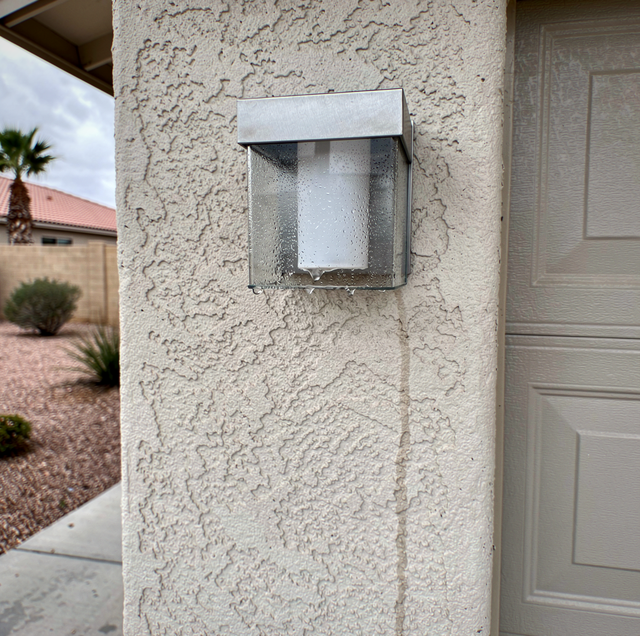
An outdoor light fixture can look sealed on every side and still take on water because the parts that keep rain out are soft, age, and depend on how the fixture was hung. A gasket seals the lens while it stays flexible. A drain opening works while it points down. The wall plate keeps water out of the electrical box when it's sealed to the wall. When water turns up in a globe or lens after a storm, one of those defenses has let go, and the place where the water collects can point to which one.
Treat a fixture with water in it as live. The wall switch is not a dependable cutoff, so the circuit breaker trips before anyone touches, tilts, or opens the fixture, and a fixture holding water is never drained with the power on.
Damp-Rated or Wet-Rated: Which Fixture Belongs on That Wall?
Every outdoor fixture carries a location rating, printed on a label inside the housing or on the carton it shipped in. A damp-rated fixture is built for spots that see moisture but not falling or blowing water, such as a roofed porch ceiling or a covered patio. A wet-rated fixture is built to take rain, spray, and water running over it, with its lens seal and wiring compartment designed to stay closed against direct water.
The two can look identical from the ground, which is how the mismatch gets installed. A damp-rated lantern moved from a porch ceiling to an open wall beside the garage door meets rain its design did not plan for. Wind matters too: a fixture under an eave stays dry in rain that falls straight down and can be soaked when a storm pushes water sideways, which can explain a light that went years without trouble and then filled in one night.
If the label says damp and the wall takes direct or wind-driven rain, resealing does not change what the housing was built for, and the repair is a wet-rated fixture.
How Do Gaskets, Lenses and Seals Wear Out?
A wet-rated fixture stays wet-rated only as long as its seals hold. The gasket between the lens and the housing is a rubber or silicone ring, and sun, heat, and years of compression age it. The surface hardens, fine cracks open, and the ring stops springing back against the glass. A gasket in that state can appear intact when the fixture is closed, yet leave gaps along its length.
Lenses fail on their own schedule. Clear plastic can yellow, turn brittle, and craze with hairline cracks that let water wick through. Glass can crack from an impact, from a screw tightened hard against it, or from thermal shock when cold rain strikes a globe warmed by an incandescent or halogen lamp. A loose retaining ring or set screw can cause the lens to sit off its gasket even when both parts are sound.
A gasket left twisted or pinched after a bulb change can explain a fixture that stayed dry for years and started filling right after routine maintenance.
Can the Mounting Itself Funnel Water Inside?
Yes. A sound fixture hung the wrong way can collect water in every storm.
No seal at the wall plate: The canopy, the flat plate that covers the electrical box, has to sit tight against the wall. Stucco, brick, and lap siding are uneven, and a flat plate pressed against them leaves gaps. Rain running down the wall finds those gaps at the top edge and slips behind the plate toward the box. A foam gasket, a bead of exterior sealant, or a mounting block that gives the canopy a flat face closes that route.
Upside-down mounting: Some wall lanterns can be hung with the lamp pointing down or standing up, and some are rated for wet locations in only one of those positions. Flipped the other way, a vented top becomes an open cup facing the sky, and a drain hole intended for the bottom ends up on top, where it lets rain in and lets nothing out. The label or installation sheet shows the approved orientation.
A missing or blocked weep hole: Some fixtures have a small drain opening at their lowest point so that water that gets past a seal or condenses inside can run out. Paint, sealant, an insect nest, or a fixture rotated a few degrees on its mount can close that opening or lift it off the low point. Once it stops working, water that gets in has no way out.
The Box Behind the Fixture and the Wall Penetration
Behind every wall fixture sits an electrical box where the house wiring meets the fixture leads, and a hole where the cable or conduit enters the wall. Both can bring water in from behind, where no lens or gasket stands in the way.
A box set back from the face of the wall, or fitted into an opening cut wider than the box, leaves a gap at its edge, and water that gets behind the canopy drops straight into it. On lap siding, a box fastened over the laps without a flat mounting block leaves wedge-shaped openings along the top. An unsealed cut around the box, or a cable hole through the sheathing, lets water into the wall cavity itself.
Water can also come from above. A leak at a window head, a failed flashing, or a gutter spilling over the fascia can send water down the back of the wall covering, and the electrical box can be the first opening it reaches. A porch ceiling fixture sits directly under the roof, so a roof leak or an open roof penetration above it can drain through its box and out through the lens. Water entering an unsealed conduit fitting higher up can also flow down the pipe to the box. In those cases, the fixture still leaks even with a perfect lens and gasket, and resealing it without identifying where water enters the building leaves the source in place.
Is It Condensation or a Leak?
Water inside a fixture does not always come from rain getting in. An enclosed housing holds a pocket of air that expands when the lamp or the day warms it and contracts when the fixture cools, pulling outside air in through every small gap. After a storm, that air is loaded with moisture, and when it meets the cool inside surface of the lens, the moisture condenses into droplets. A fixture can cycle this way for nights on end and collect visible water with no leak at all.
The two leave different marks:
- Condensation: Fog or fine droplets spread across the inside of the lens, clearing as the fixture warms and returning as it cools, and it can appear on clear nights with no rain.
- Leak: Water pooled at the lowest point, drip trails running from one spot, mineral rings, rust at a screw or seam, and water that appears after rain and not otherwise.
Condensation behind a blocked drain can create pooled water, just as a leak does, so an open drain is part of the fix for both. When the pattern is unclear, keep the breaker off, empty and dry the globe or lens only, and look again after the next rain and after a clear, cool night; whichever brings the water back names the cause.
What Happens to the Wiring, the Socket and the GFCI?
Water that reaches the socket goes after the metal first. The screw shell and the contacts corrode, bulbs start to flicker or seize in place, and a bulb base rusted into its socket can snap off when someone tries to unscrew it. Corroded wire connections in the box run hot under load. Standing water also provides a path for current from the hot conductor to the metal box, the housing, or the ground wire, which is one way a wet fixture ends up with an energized housing.
On a circuit with ground-fault protection, water in the fixture or its box can trip the GFCI, though repeated GFCI trips have causes well beyond a single wet light. When a GFCI or breaker trips again right after it is reset, leave it off. Each reset sends power back into the same wet fixture and the same fault the device just stopped.
Water inside a light fixture can carry current to the metal housing, the canopy, and its mounting screws. Leave opening the box, drying the connections, and any rewiring to a licensed electrician, with the breaker off from start to finish.
Where the Water Sits, What Let It In, and the Fix
Each row pairs a place where water collects with the gap that can let it in and the repair that closes it.
| Where the water sits | What let it in | The fix |
|---|---|---|
| Fog or fine droplets across the lens, no pooling | Humid air drawn in as the housing cools | Open drain path and a gasket seated evenly |
| A pool in the bottom of the globe or lens | Hardened gasket, cracked lens or loose retaining ring | New gasket or lens, or a new fixture where parts are not sold |
| Water in the top of an inverted cup | Fixture hung in an orientation it is not rated for | Remount in the rated position or replace |
| A pool that stays put, fixture otherwise sound | Weep hole painted over, sealed or rotated off the low point | Reopen or reposition the drain |
| Wet canopy plate and wet wall behind it | Gap between the canopy and an uneven wall surface | Gasket, sealant or a flat mounting block |
| Water in the box and around the connections | Wall penetration, a roof, window, or flashing leak above, or a conduit run | Trace and seal the entry, then dry or replace the connections |
| Whole housing filling on an exposed wall | Damp-rated fixture taking direct rain | Wet-rated fixture |
When two rows apply at once, such as a cracked lens on a damp-rated lantern, fixing the lens alone leaves the rating problem in place.
Frequently Asked Questions
Drilling alters a rated fixture, and the damp rating it carries may no longer apply to the modified housing. A bit can also crack a cast housing. If a fixture has no working drain and keeps collecting water, a replacement with a drain in the right place fixes it without compromising the rating.
No. With the breaker off, seal the top and both sides of the canopy, leaving the bottom edge open. A bead along the bottom traps any water that gets behind the plate and holds it against the box, where it has no way to drain out. Use an exterior-grade sealant suited to the wall surface; interior acrylic caulk can crack and pull away outdoors.
Drying removes the water but not what it left behind. Minerals and corrosion can coat the insulating ring that separates the socket's screw shell from its center contact, and that film conducts again the moment it gets damp. A fixture that recovers after every dry spell can be heading toward a socket that shorts, so recovery does not mean the problem solved itself.
An LED bulb carries its driver electronics in its base, and moisture reaching that base can kill the bulb even where an incandescent filament would keep glowing. LED bulbs also run cooler, so the housing warms less and condensation a hot bulb used to drive off can linger. For a closed globe, choose a bulb marked for enclosed fixtures; for an exposed fixture, choose one marked for damp locations.
Yes. A sensor head is a separate opening in the housing with its own seal, and its swivel joint can open a gap once the head has been turned. A sensor aimed upward catches rain on its face and lets it run down into that joint. Aimed level or slightly down, the head sheds water off its lower edge instead.
They can, and they hit it from below and from the side, directions a roof overhang does not shield. A spray head aimed at a wall or post light wets the bottom edge, the drain opening, and the underside of the canopy on every watering cycle, and can leave mineral deposits that close the drain. Turning the head away removes that source.
Put an outdoor fixture reseal or wet-rated replacement on the calendar — the lens, gasket, wall plate and box sealed so rain stays out. Zimmerman Electric Company serves Surprise, Sun City, and Peoria. Call (602) 497-3365.