
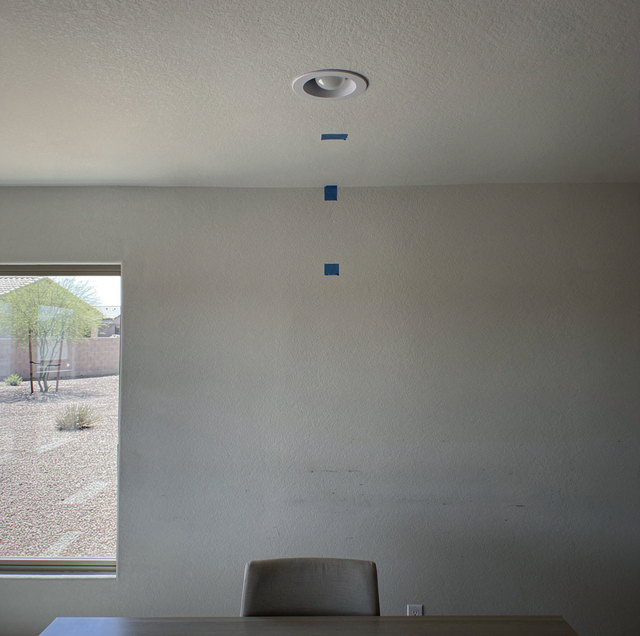
A dining light ends up off-center for reasons that were settled long before the table arrived. During framing, the ceiling box goes up where the plans or the electrician's best estimate put it, fastened to the nearest joist, so its position follows the framing rather than the furniture. Later the table changes: a long rectangle replaces a round one, the room gets rearranged, or a remodel opens a wall, and the dining space shifts with it. Moving the drop point back over the table is both a wiring and a ceiling-structure question, because the circuit has to reach a new spot and that spot has to hold a fixture. Only some of the approaches move any wiring, and they differ in what each needs above the ceiling, what becomes of the old opening, and how the finished room looks.
| Approach | What it needs above the ceiling | What happens to the old opening | What it changes about the look |
|---|---|---|---|
| New ceiling box at the table's center, circuit extended from the old box | A cable path between the two boxes, plus framing or a brace for the new box | Stays in place as a junction box under a blank cover | Fixture centered; a flat plate remains where the light used to hang |
| New run from the switch or another point on the circuit | A cable path from there to the new spot | Can be removed and patched when nothing else is spliced in it | Fixture centered, possibly with no leftover plate |
| Swag from the existing box | No wiring change; a hook goes in at the new drop point | Keeps feeding the fixture through its canopy | A draped chain and cord cross the ceiling |
| Fixture built to shift its drop point along a canopy or rail | Nothing, if the new spot falls within the canopy's or rail's reach | Covered by the fixture's own canopy or rail feed | A long canopy or rail becomes part of the fixture |
| Leave the box and move the table | Nothing | Unchanged | The table sits off the room's center line and walkways around it change |
What Sits Above the Ceiling Decides the Route
An attic over the dining room gives open access from above. The new box can be set from the attic side and fastened to the framing; cable can be laid over or along the joists to reach it, and the only new hole in the room below is the one the box sits in.
A finished floor above closes that access. The space between the dining ceiling and the floor overhead is a row of enclosed bays, one between each pair of joists, and short of lifting the floor above, cable reaches the new spot by being fished through them from below. Once the ceiling is closed, the joist direction determines how much of it is opened.
Along the joists: When the new center point falls in the same bay as the old box, the cable can travel down that bay between the two openings, and the ceiling work stays close to the size of those two holes.
Across the joists: When the new point sits on the far side of one or more joists, the cable must pass through each joist in its path. That means boring a hole through every joist it crosses, keeping it well back from the top and bottom edges so the joist retains its strength, and reaching each one with a long, flexible bit worked through a small opening or an access hole cut at each crossing. A short move across two joists can need more ceiling openings than a longer move down a single bay.
Insulation, a duct, or a drain line from an above bathroom can block a bay outright, and then the route goes around the obstruction, or the plan shifts to one of the approaches that moves no wiring.
The Old Box Stays Reachable
Extending the circuit from the old box leaves splices inside it, because the conductors that fed the fixture now join a new cable heading to the center point. Every splice has to stay in a box that can be reopened without cutting into the ceiling, so the old box keeps its place and a flat, blank cover is screwed over it. The cover can be painted the ceiling color and remains removable.
A splice is never pushed up into the ceiling cavity with the hole patched over it, and a box is never drywalled shut. A connection that loosens or runs hot inside a sealed ceiling can heat the framing around it without anyone noticing.
The old box can also hold more than the fixture's own feed. Depending on how the house was wired, power for other lights or outlets can pass through it on its way elsewhere, and in that case, the box serves as a junction no matter which approach is chosen. It only appears when a new run reaches the center point from another location, and nothing else is spliced into it. The dead cable is then disconnected at its other end as well, the box is removed, and the opening is filled.
The New Box and What Holds It
The new box has to be rated and supported for the fixture that will hang from it. Its position comes from the table rather than the room: the drop point is measured from the table's center with the table in the place it will stay, since a dining room's center and its table's center are two different points whenever the table sits closer to one wall.
A square of painter's tape on the ceiling over the table's center, marked with the table in its final spot, shows which joist bay the new box falls in, and the route follows from that mark.
The hole cut for the box must be smaller than the fixture's canopy so the canopy closes over it. A narrow canopy leaves little margin for a ragged cut or a box set slightly off the mark.
Keeping the Same Switch and Dimmer
A relocated fixture stays on its existing switch when the switched conductor reaches the new box, and the way that happens depends on where the power enters.
Power at the switch: Power reaches the switch box first, and a single cable carries the switched conductor and the neutral to the light. The old fixture box then holds only that cable, which makes a new run from the switch box a clean option and can free the old box to come out.
Power at the fixture: Power arrives at the fixture box first, and a separate cable drops down to the switch and back. The old box then holds the always-live supply, the conductor returning from the switch, and sometimes cables feeding onward to other rooms. In this layout, the old box remains a junction, and the extension branches from it.
Where the dining light answers to switches at two doorways, the conductors that link those two switches can pass through the fixture box as well, and they have to stay intact for both switches to keep working.
A dimmer carries over as long as its rating covers the new fixture's load and it is compatible with the fixture's lamp type. A mismatched pairing can flicker or hum, which is a dimmer question rather than a relocation question.
Swags, Canopies and Leaving the Wiring Alone
A swag keeps the box and moves the light. The fixture's cord runs from the canopy at the old box, threaded through the chain, to a hook above the table's center, and nothing is spliced anywhere new. The trade is visual: the draped chain and cord become part of the room, and some fixtures do not come with a cord long enough, or a chain designed, to carry a swag.
A fixture made to shift its drop point does the same job along a tidier line. Some linear fixtures hang their pendants from a long canopy with movable ports, and rail or monorail systems let a pendant hang anywhere along the rail while drawing power from the one box. These reach only as far as the canopy or rail extends, so the distance from the box to the table's center decides whether one fits.
None of these approaches involves an extension cord run across the ceiling or a hanging fixture plugged into a wall outlet with its cord draped overhead. A cord stapled or clipped to drywall can be pinched or overheated where nobody sees it. A swag uses the fixture's own cord, connected inside the ceiling box.
Moving the table belongs on the list too: in some rooms the old box lines up with a table position that leaves clearer walkways past doorways and cabinets.
Power Off and the Permit Question
Every wiring approach begins at the breaker, because a wall switch cannot be trusted as a cutoff: where power arrives at the fixture box, conductors in that box stay live with the switch off, and a switch wired on the wrong conductor can leave the fixture's socket live as well. Before a canopy comes down, the breaker for that circuit goes off, and every conductor in the box is tested dead.
With the wall switch off, the supply splices inside an old fixture box can still carry full voltage and shock anyone who reaches in. The canopy stays closed until an electrician shuts off the breaker and tests each conductor dead.
Opening the old box, splicing an extension, and running new cable is an electrician's work from start to finish. Whether a relocation needs a permit is the local building department's call.
The Ceiling Afterward
Patching, texturing, and painting the old opening and any access holes is finish work that follows the electrical work as a separate step. A textured ceiling, such as knockdown or a sprayed popcorn finish, needs its texture matched over each patch, and in an older house a sprayed texture is tested for asbestos before anyone cuts or sands it. Ceiling paint that has aged can differ in shade from fresh paint on the same surface, which leads some owners to repaint the whole ceiling rather than just the patches.
At the new location, a ceiling medallion around the canopy can frame the fixture and cover the edge of a cut that came out wider than the canopy.
Frequently Asked Questions
Then the joist becomes backing rather than an obstacle. A shallow box mounted directly against the underside of a framing member can sit on it, as long as it has room for the conductors it holds and the fixture's canopy covers it. The other answer is shifting the point a short way into the next bay, and over a long table, a small shift along its length can go unnoticed.
It can. A table that splits in the middle and takes its leaf there opens evenly from both ends, so its center stays put. A table whose leaf adds length at one end only moves its center by half the leaf's length whenever that leaf is in, so the point is marked with the table set the way it sits day to day.
Yes, with a fixture built for it. The box follows the slope, and the fixture needs a canopy with a swivel or a sloped-ceiling adapter so its chain or stem hangs straight down rather than square to the ceiling plane. A fixture without that feature hangs crooked on an angled ceiling, however carefully the box is placed.
Yes. The extension carries an equipment grounding conductor along with the hot and the neutral, and that conductor connects to the fixture and, in a metal box, to the box itself. Older wiring with no grounding conductor in the old box changes what the new run can connect to, and that gets settled before the extension goes in.
They can. A lighting circuit can serve fixtures and outlets in several rooms, and everything on it goes dark while its breaker is off. Panel labels can also be incorrect or out of date after years of changes, which is another reason the conductors are tested at the box rather than trusting the directory.
The hook does. The chain passes the fixture's weight to the swag hook, so the hook screws into a joist or, between joists, into a toggle-style anchor rated for the load. A hook driven into bare drywall alone can pull out under a chandelier's weight.
Arrange a dining room light fixture relocation — the fixture's drop point is moved over the table's center, with any old box left accessible and the existing switch still in control. Zimmerman Electric Company serves Surprise, Sun City, and Peoria. Call (602) 497-3365.